Host-microbiome crosstalk
In plain language
Picture your body as a bustling city. Your genes are the blueprints, your metabolites the traffic, and your microbiome the millions of inhabitants that bring the whole to life. If communication between those layers runs smoothly, the city runs well; if it falters, jams arise: digestive complaints, brain fog or fatigue. That communication is called crosstalk: the ongoing back-and-forth between human and microbiome. It is not only about digestion, but also about the production of neurotransmitters, the fine-tuning of your immune system and the production of substances that temper inflammation and supply energy. Crosstalk is therefore not an abstract concept, but the daily working language of your health — and precisely for that reason a handy compass to understand why your body responds the way it does.
The science behind
Crosstalk runs along several channels at once. When fiber is digested, gut bacteria produce short-chain fatty acids (SCFAs) such as butyrate, propionate and acetate; these feed the gut wall cells, temper low-grade inflammation and supply energy. At the same time, bacteria steer the production of neurotransmitters (including serotonin and GABA) and train the immune system in distinguishing friend from foe. In this way the dialogue is never one-way: the host provides nutrition and a living environment, the microbiome supplies signals in return.
Research in Nature Reviews Microbiology describes this host-microbiome dialogue as crucial for both health and disease. Certain bacteria, such as Faecalibacterium prausnitzii, send anti-inflammatory signals to the gut wall; if their voice disappears, the chance of low-grade inflammation rises (The Lancet Microbe). Via the gut–brain axis the same crosstalk influences mood and focus, and via the metabolism it helps determine how efficiently you extract energy from food. Only with a multi-omics view — DNA, metabolome and microbiome together — does the full conversation become visible instead of separate words.
The core is co-metabolism: health does not arise from one gene or one bacterium, but from the interplay between DNA, microbiome, metabolites and lifestyle. That is why the same advice does not work equally well for everyone, and crosstalk is a lens that explains why responses are so personal. This reading is supportive and observational — not a medical diagnosis.
Illustration & CosmoTalks
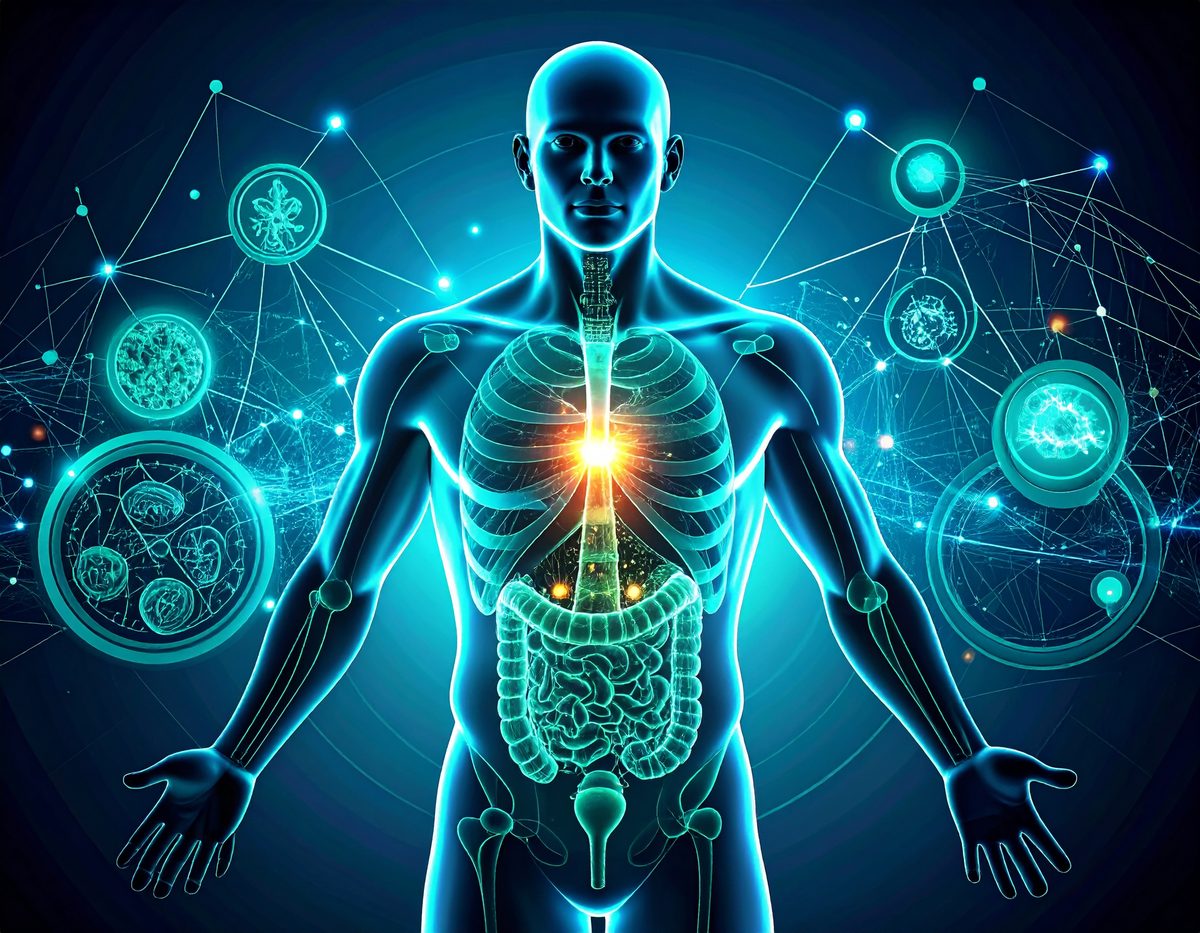
You and your microbes as one ecosystem — in five short episodes about collaboration in your body.
- S1·E1 — You are never alone: the idea of the holobiont
- S1·E2 — Crosstalk: how cells and microbes talk to each other
- S1·E3 — Who feeds whom? Symbiosis in the gut
- S1·E4 — When the conversation stalls: dysbiosis
- S1·E5 — One ecosystem, one health
Related concepts
Explore further in the Cosmogroup ecosystem
From knowledge to application — choose your next step.
My InnerSelfie
Follow the dialogue between your layers: DNA, microbiome and metabolites together, translated into clear signals.
Discover My InnerSelfie →My Key Nutrients
Feed the good side of the crosstalk: prebiotic fibers and postbiotics that strengthen anti-inflammatory signals.
View the range →CosmoPulse
For performance environments: adaptation and recovery as a readable decision signal.
Discover CosmoPulse →The books · HOST · FORMULA · EDGE
The common thread of this science, from insight to everyday application, by Petra Van Gucht.
See the books →Scientific references
• The Lancet Microbe (2022) — Faecalibacterium prausnitzii and mucosal anti-inflammatory signaling.
• Cell Metabolism (2021) — Gut microbial metabolites and host energy metabolism.
• Van Gucht P. — HOST (COSMO trilogy): crosstalk as the language of collaboration in the body.
Frequently asked questions
- What is host-microbiome crosstalk?
- It is the continuous, two-way dialogue between your own cells and your gut microbiome, via metabolites, immune signals and neurotransmitters.
- Why is crosstalk important for my health?
- Because the quality of that conversation helps determine how you digest, how your immune system responds and how much energy and focus you have left.
- Can I influence my crosstalk?
- Often you can — through nutrition (especially fiber), rhythm and movement. What works best differs from person to person, because it depends on your co-metabolism.
- Why do I need multi-omics to see crosstalk?
- Separate tests show one layer. Only by bringing together DNA, microbiome and metabolites does the whole conversation become visible instead of separate words.
Hooked on co-metabolism?
You have just read one piece of the puzzle. There is a path for the curious who want to understand themselves better — and a deeper library for the professional who works with it.
Discover your own story
Curious what co-metabolism means for you? Discover what your own body is trying to tell you every day — and stay up to date with new insights.
Discover your analysis →Join us and gain access
Become an affiliated healthcare professional and unlock the depth we reserve for our partners: the books to read online, the Well@Work and Sport experiences, the protocols and a network of like-minded peers.
Join us →