
The gut–skin axis
In plain language
Anyone dealing with eczema, psoriasis, vitiligo or hair loss is often told it is “something to do with the skin”. Yet that is only part of the story. Many of these conditions come with chronic inflammation and treatment resistance — and the gut turns out to have a say in it. Your gut flora trains your immune system, produces inflammation-dampening substances and supplies building blocks that even influence the pigment cells of your skin. When that flora falls out of balance, the skin can bear the consequences: more flare-ups, slower healing, more stubborn complaints. That also explains why people respond so differently to the same cream or treatment. The skin is a window onto what is happening deeper in the body.
The science behind
A key mechanism in the gut–skin axis runs via the immune system. Gut bacteria help steer the balance between pro-inflammatory Th17 cells and regulatory Treg cells; if that balance tips, it feeds skin inflammation such as psoriasis and eczema. Indole derivatives that activate the AhR (aryl hydrocarbon receptor) — a receptor that helps dampen inflammation in the skin — are important here. In dysbiosis, the production of these AhR ligands falls, so the brake on inflammation is released.
Pigmentation is also connected to the gut. In vitiligo, one sees a reduced microbial diversity and specific shifts in metabolites that influence the function of melanocytes (pigment cells). In addition, a more porous gut wall can let bacterial fragments circulate that disrupt the skin barrier and oxidative stress. Post-viral dysbiosis — for example after COVID — can trigger prolonged skin inflammation via the same immune crosstalk.
Why one patient reacts strongly and another barely at all is co-metabolic: it depends on the interplay between genetic predisposition, microbiome, metabolites and lifestyle. Genes color the sensitivity, but the whole determines the picture. This reading is supportive and observational — not a medical diagnosis.
Illustration & CosmoTalks
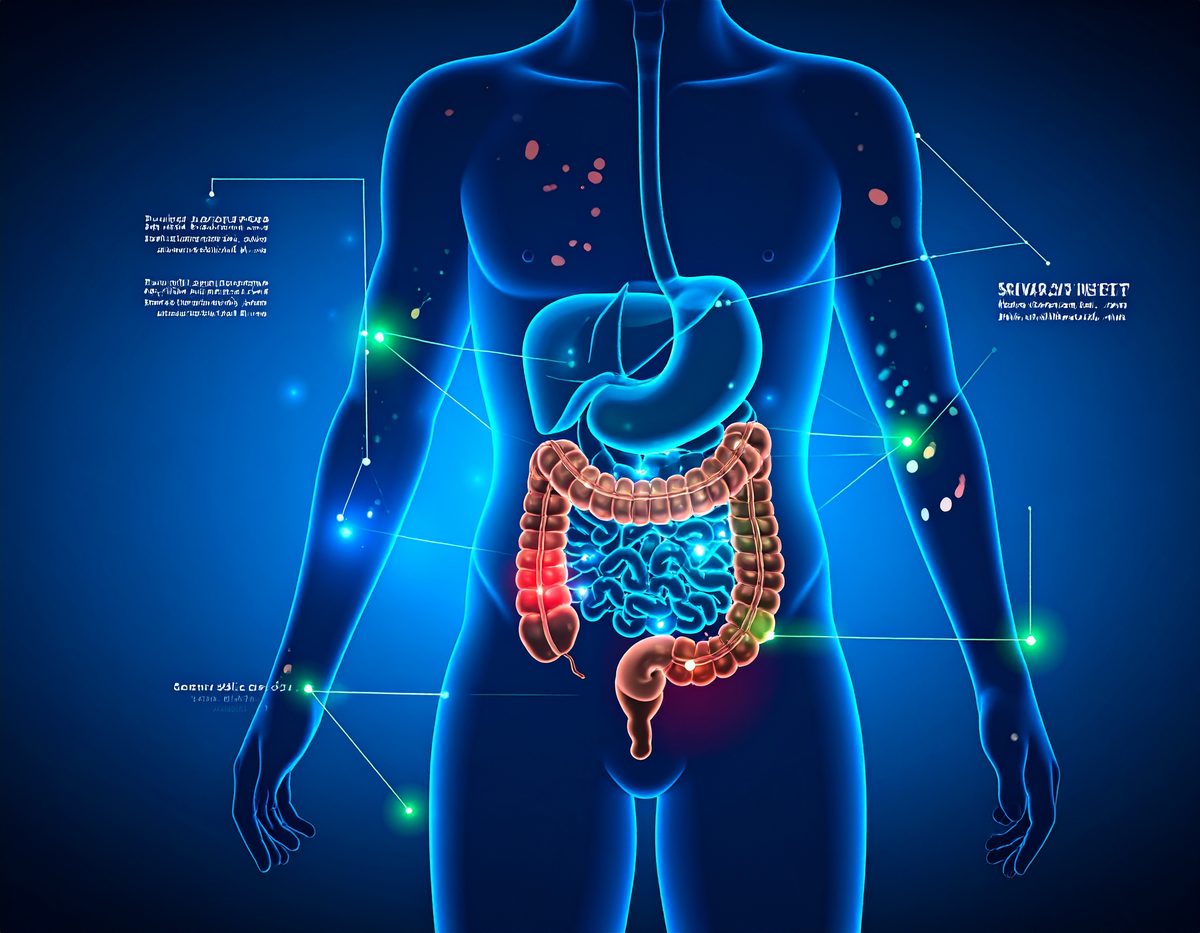
Your body is not a collection of separate organs, but one cooperating whole — human and microbes.
- S1·E1 — Why you’re never alone: the human as an ecosystem
- S1·E2 — How your gut talks to your heart, liver and kidneys
- S1·E3 — Metabolites: the language between your organs
- S1·E4 — When the dialogue falters: dysbiosis and inflammation
- S1·E5 — Understanding one whole instead of separate complaints
Related concepts
Explore further in the Cosmogroup ecosystem
From knowledge to application — choose your next step.
My InnerSelfie
Reveal how immune and metabolite profiles from the gut influence your skin, translated into clear signals.
Discover My InnerSelfie →My Key Nutrients
Support the skin barrier from within: inflammation-aware nutrition, polyphenols and postbiotics tailored to your co-metabolism.
See the range →CosmoPulse
For performance settings: readiness, adaptation and recovery bundled into one readable decision signal.
Discover CosmoPulse →The books · HOST · FORMULA · EDGE
The through-line of this science, from insight to everyday application, by Petra Van Gucht.
See the books →Scientific references
• Nigro E., et al. (2025) — Gut and skin microbiome in vitiligo: a systematic review. Arch Dermatol Res.
• Pai S., et al. (2025) — Th17/Treg balance and the gut–skin axis in psoriasis and eczema. IJDVL.
• Van Gucht P. — HOST (COSMO trilogy): the skin as a window onto the gut.
Frequently asked questions
- What is the gut–skin axis?
- The interplay between your gut microbiome and your skin. Via immune activation, oxidative stress and metabolites, the gut helps influence the skin barrier, inflammation and pigmentation.
- Can my gut worsen eczema or psoriasis?
- The gut flora helps steer the immune balance (Th17/Treg) and the production of inflammation-dampening AhR ligands. If that balance is disrupted, it can feed skin inflammation.
- Why does everyone respond differently to the same cream?
- Because the underlying immune and microbiome profiles differ. What works best depends on your co-metabolism.
- Does vitiligo have anything to do with the gut?
- Research shows a reduced microbial diversity in vitiligo and metabolites that influence pigment cells. This is a supportive reading, not a diagnosis.
Hooked on co-metabolism?
You’ve just read one piece of the puzzle. There’s a path for the curious who want to understand themselves better — and a deeper library for the professional who works with it.
Discover your own story
Curious what co-metabolism means for you? Discover what your own body tries to tell you every day — and stay up to date with new insights.
Discover your analysis →Join us and get access
Become an affiliated healthcare professional and unlock the depth we reserve for our partners: the books to read online, the Well@Work and Sport experiences, the protocols and a network of like-minded peers.
Join us →