
The gut–kidney axis
In plain language
The kidneys filter waste products from your blood, but they do not do this alone: they are in close contact with the gut. In chronic kidney disease, urea and toxins rise, resulting in fatigue, vascular damage and a weakened immune system. Part of those toxins do not come from the kidney itself, but from the gut: certain bacteria produce substances that place extra strain on the kidneys. Other bacteria do exactly the opposite and help clear them away. The gut is therefore both a source of strain and an ally in detoxification. In acute kidney injury, moreover, we see that a leaky gut wall sets off systemic inflammation. Those who map this conversation understand better why kidney disease progresses faster in one person than in another.
The science behind
In chronic kidney disease (CKD), uremic toxins of microbial origin play a key role. Substances such as indoxyl sulfate and p-cresol are formed by gut bacteria and burden the kidneys and blood vessels. The microbiome is thereby partly decisive for the toxin load: some compositions amplify toxin production, others temper it. A shifted gut flora can thus speed up or slow down the progression of CKD.
Uric acid and immunity also run via this axis. Research shows that certain gut bacteria — such as Akkermansia muciniphila — can lower uric acid and mitigate hyperuricemia via gut–kidney crosstalk. In IgA nephropathy, specific microbial profiles help steer IgA aggregation and kidney inflammation. And in severe illness, such as sepsis, the gut–kidney–lung crosstalk becomes disrupted, which worsens systemic damage via inflammatory pathways such as NF-κB.
The outcome is co-metabolic: how your kidneys hold up depends on the interplay between genes (including detox pathways), microbiome, metabolites and lifestyle — not on one toxin or one bacterium. That explains the large differences in disease course between people. This reading is supportive and observational — not a medical diagnosis.
Illustration & CosmoTalks
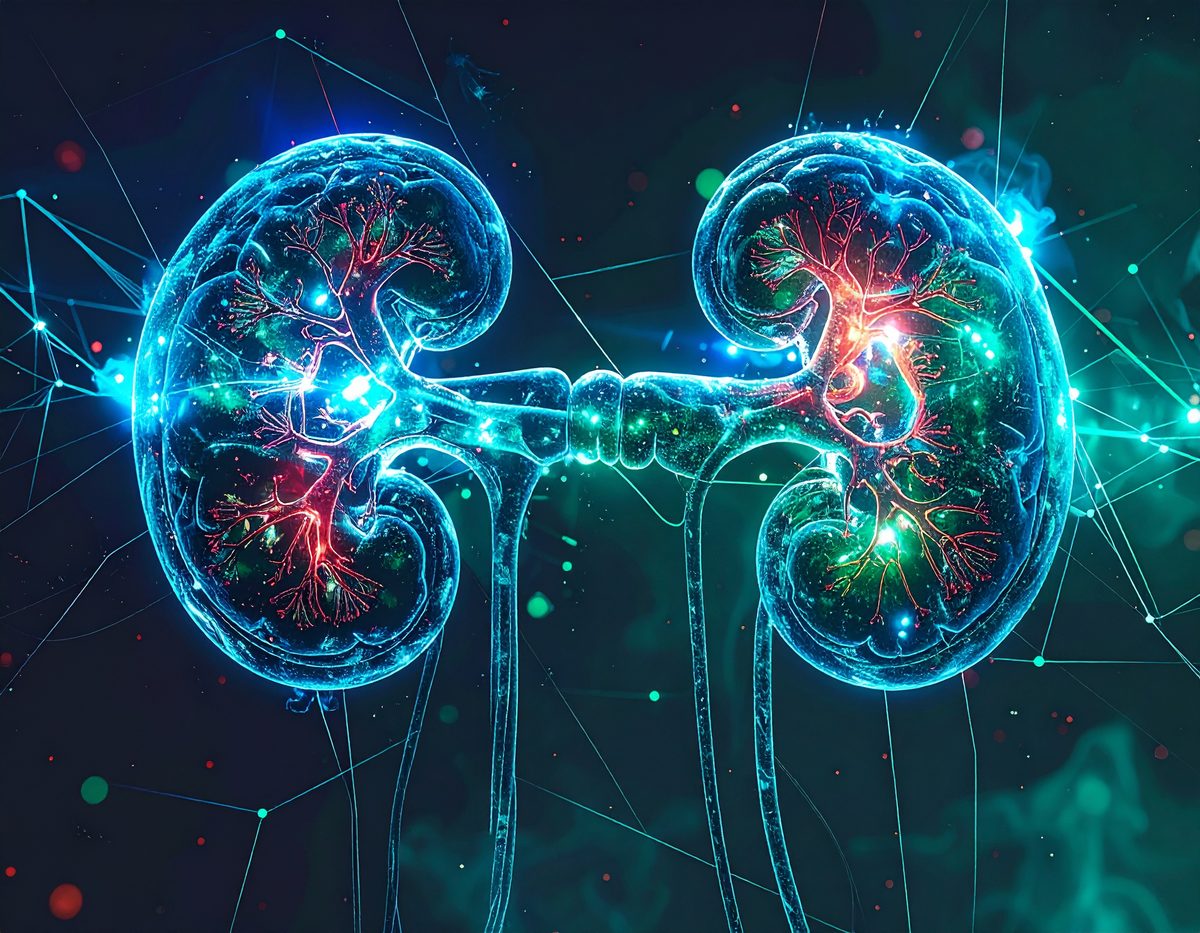
Your body is not a collection of separate organs, but one cooperating whole — human and microbes.
- S1·E1 — Why you’re never alone: the human as an ecosystem
- S1·E2 — How your gut talks to your heart, liver and kidneys
- S1·E3 — Metabolites: the language between your organs
- S1·E4 — When the dialogue falters: dysbiosis and inflammation
- S1·E5 — Understanding one whole instead of separate complaints
Related concepts
Explore further in the Cosmogroup ecosystem
From knowledge to application — choose your next step.
My InnerSelfie
Map the gut–kidney dialogue: microbial toxins and detox pathways together with DNA and metabolites, translated into readable signals.
Discover My InnerSelfie →My Key Nutrients
Support your detox balance from within: fiber-rich, toxin-buffering nutrition and formulas tailored to your co-metabolism.
See the range →CosmoPulse
For performance settings: readiness, adaptation and recovery bundled into one readable decision signal.
Discover CosmoPulse →The books · HOST · FORMULA · EDGE
The through-line of this science, from insight to everyday application, by Petra Van Gucht.
See the books →Scientific references
• Wang X., et al. (2025) — Multi-omics of gut–kidney crosstalk in IgA nephropathy. Theranostics.
• Ali H., et al. (2024) — Gut barrier loss and systemic inflammation in AKI. Int Urol Nephrol.
• Van Gucht P. — HOST (COSMO trilogy): the gut as a co-player in detoxification.
Frequently asked questions
- What is the gut–kidney axis?
- The dialogue between your gut microbiome and your kidneys. Microbial toxins, uric acid and immune activation help influence kidney function in chronic and acute kidney disease.
- Which toxins come from the gut?
- Among others indoxyl sulfate and p-cresol: substances that gut bacteria produce and that place extra strain on the kidneys and blood vessels.
- Can the gut also help in kidney disease?
- Yes — some bacteria buffer toxins or lower uric acid. The gut is therefore both a burden and an ally in detoxification.
- Why does kidney disease progress differently in everyone?
- Because it depends on the interplay between genes, microbiome, metabolites and lifestyle. This reading is supportive, not a diagnosis.
Hooked on co-metabolism?
You’ve just read one piece of the puzzle. There’s a path for the curious who want to understand themselves better — and a deeper library for the professional who works with it.
Discover your own story
Curious what co-metabolism means for you? Discover what your own body tries to tell you every day — and stay up to date with new insights.
Discover your analysis →Join us and get access
Become an affiliated healthcare professional and unlock the depth we reserve for our partners: the books to read online, the Well@Work and Sport experiences, the protocols and a network of like-minded peers.
Join us →