
Overtraining & injury prevention
In plain language
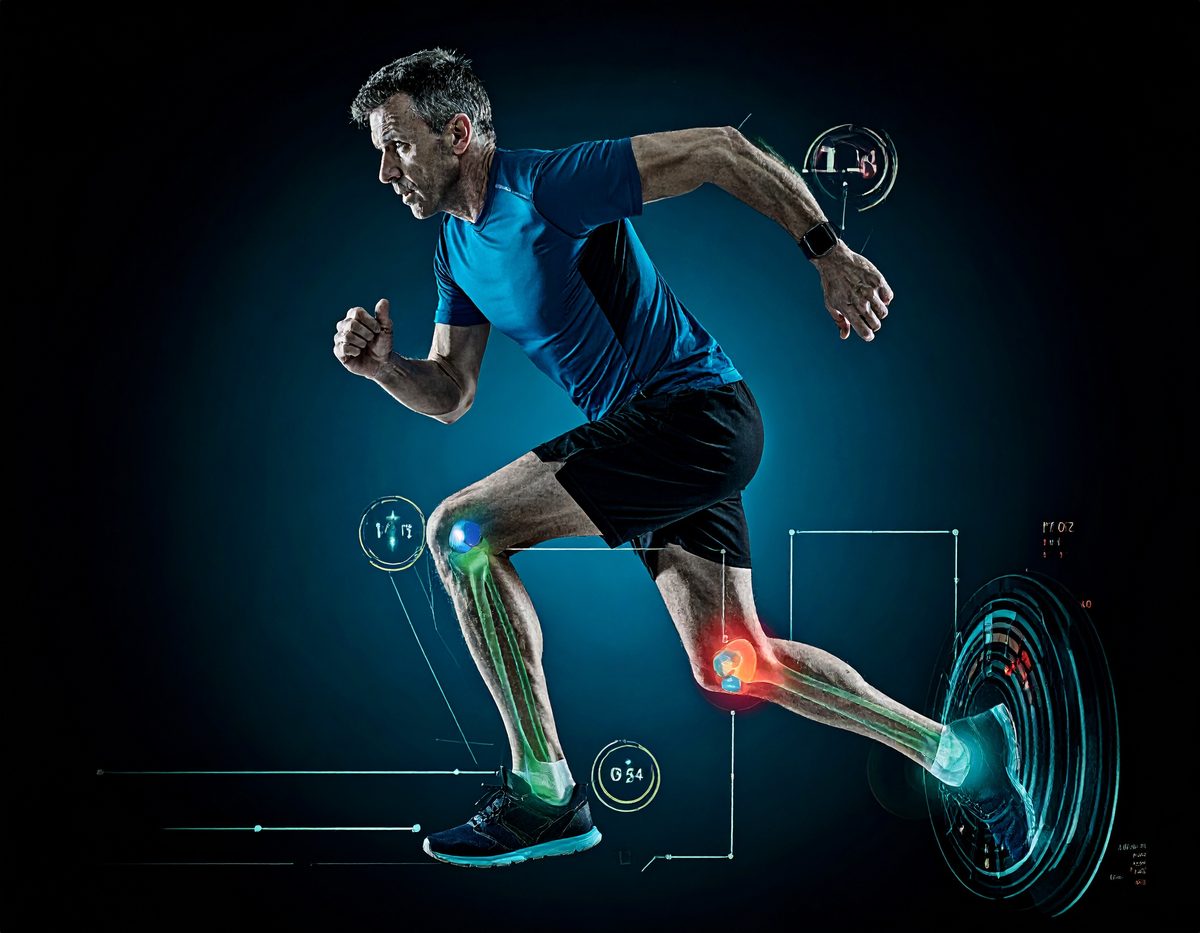
A driven man in his fifties decides to run a marathon and approaches it the way he approaches his work: a tight schedule, clear goals, discipline. Yet after a few months the knee pain, ankle complaints and stiffness set in. His willpower is strong, but his body is working against him. Why? Training does not make you stronger during the effort itself, but during the recovery afterward. Whoever stacks up too much load without enough recovery — through busyness, sleep deprivation or stress — does not train themselves forward but into the ground.
Injuries rarely arise from one wrong movement. Usually it is months of a disrupted balance between load and recovery that eventually break somewhere. And that balance is different for everyone: your predisposition for muscle fiber type, your recovery speed and the degree of smouldering inflammation in your body all help determine how much you can take. A schedule that suits one runner is a recipe for injuries for another. Training smarter therefore starts with knowing your own biology, not with wanting to push harder.
The science behind
Injuries in recreational athletes rarely arise purely mechanically. Work in Sports Medicine describes how most overuse injuries stem from a mismatch between load and recovery: the body is given insufficient time to adapt to the accumulated training stimulus. Periodization — dosing intensity, volume and rest — is therefore not a luxury but the core of injury prevention. Without recovery, training shifts from adaptation (becoming stronger) to maladaptation (exhaustion and damage).
Underneath that balance lie individual biological factors. Publications in Frontiers in Sports Science describe how gene variants associated with muscle fiber type and muscle structure (including around ACTN3) color the predisposition for strength versus endurance and help determine injury risk. In addition, markers of oxidative stress and low-grade inflammation influence how quickly tissue recovers. Work in Nature Reviews Endocrinology shows that stress, sleep and microbiome communication together steer adaptation to training — through SCFAs, the microbiome supplies building blocks and inflammation damping that support recovery.
The common thread is co-metabolism: whether someone progresses injury-free or keeps breaking down arises from the interplay of DNA, microbiome, metabolites and lifestyle together. Predisposition colors the starting position, but training dose, sleep, nutrition and recovery determine what you do with it. Injury prevention is therefore not a matter of more willpower, but of matching the training load to what your system can handle at that moment. This reading is supportive and observational — not a medical diagnosis.
Illustration & CosmoTalks
How your microbiome moves along with training, recovery and performance — five episodes.
- S4·E1 — Your gut trains too
- S4·E2 — Nutrition as fuel and as signal
- S4·E3 — Why one athlete recovers faster
- S4·E4 — Inflammation: ally and saboteur
- S4·E5 — Injuries often begin in the gut
Related concepts
Explore further in the Cosmogroup ecosystem
From knowledge to application — choose your next step.
My InnerSelfie
See which muscle fiber types dominate and how recovery, inflammation and the microbiome determine your load capacity — in a single view.
Discover My InnerSelfie →My Key Nutrients
Support recovery and a calm inflammation balance with targeted nutrition, matched to your co-metabolism.
See the range →CosmoPulse
For performance settings: readiness, adaptation and recovery bundled into one readable decision signal.
Discover CosmoPulse →The books · HOST · FORMULA · EDGE
The common thread of this science, from insight to everyday application, by Petra Van Gucht.
See the books →Scientific references
• Del Coso J., et al. (2021) — Genetics of muscle type and injury susceptibility. Frontiers in Sports Science.
• Chen Y., et al. (2022) — Stress, sleep and microbiome in training adaptation. Nature Reviews Endocrinology.
• Van Gucht P. — EDGE (COSMO trilogy): training, recovery and co-metabolism.
Frequently asked questions
- What is the difference between training hard and overtraining?
- With hard training, enough recovery follows to become stronger. With overtraining, the load structurally exceeds recovery, so you stagnate or decline.
- Why does one runner get injured and another does not?
- Predisposition for muscle fiber type, recovery speed and the degree of low-grade inflammation differ from person to person. The same load therefore plays out differently.
- What does my gut have to do with injuries?
- Through SCFAs, the microbiome supplies building blocks and inflammation damping that support recovery; a disrupted gut can slow recovery down.
- How do I prevent overload?
- Through periodization: dosing intensity, volume and rest and matching them to your recovery — not just to your ambition or a standard schedule.
Hooked on co-metabolism?
You have just read one piece of the puzzle. There is a path for the curious who want to understand themselves better — and a deeper library for the professional who works with it.
Discover your own story
Curious what co-metabolism means for you? Discover what your own body tries to tell you every day — and stay up to date with new insights.
Discover your analysis →Join us and gain access
Become an affiliated healthcare professional and unlock the depth we reserve for our partners: the books to read online, the Well@Work and Sport experiences, the protocols and a network of like-minded people.
Join us →