
Irritable bowel (IBS)
In plain language
Irritable bowel is often seen as a functional complaint without a clear cause — something you “just have to learn to live with”. Yet a growing body of research points to a complex interplay between predisposition, microbiome and environment. It is important to distinguish it from chronic inflammatory bowel diseases (such as Crohn's disease or colitis): IBS produces no structural inflammation, but it does share mechanisms, because here too the dialogue between host and microbiome becomes disturbed. That explains why one person develops complaints and another does not, even with the same food or the same stress. Anyone who examines those layers together — DNA, metabolites and microbiome — sees where the sensitivity comes from. In this way IBS becomes more understandable and more manageable, instead of an unexplained complaint.
The science behind
IBS is not an inflammatory disease, but it shares themes with inflammatory bowel diseases (IBD). A well-known genetic factor is secretor status: carriers of certain FUT2 variants (backstage factors) secrete blood group antigens into the gut mucosa that serve as food for bacteria. Non-secretors partly lack this, often have less Bifidobacterium and are more susceptible to dysbiosis — and report IBS complaints more often (Rausch et al., PNAS, 2011). Insights from IBD, such as the role of autophagy variants (ATG16L1) in regulating gut bacteria, show how host-microbiome interactions lower the threshold to complaints (Caruso et al., Nature Reviews Immunology, 2020).
Predisposition alone, however, is never enough. Environmental triggers — diet, stress, infections and medication use such as frequent NSAIDs — can tip the balance in a sensitive host (Sartor, Gastroenterology, 2010). In both IBS and IBD the bacterial composition shifts, albeit more mildly in IBS (Wlodarska et al., Cell Host & Microbe, 2015). This creates a picture of a vulnerable system that, with the right combination of triggers, tips over into complaints.
The connecting logic is co-metabolism: whether sensitivity results in complaints depends on the interplay between genetic vulnerability, microbial signature, metabolites and lifestyle. That is why a single standard approach rarely works for everyone, and why it helps to read the layers together. This reading is supportive and observational — not a medical diagnosis.
Illustration & CosmoTalks
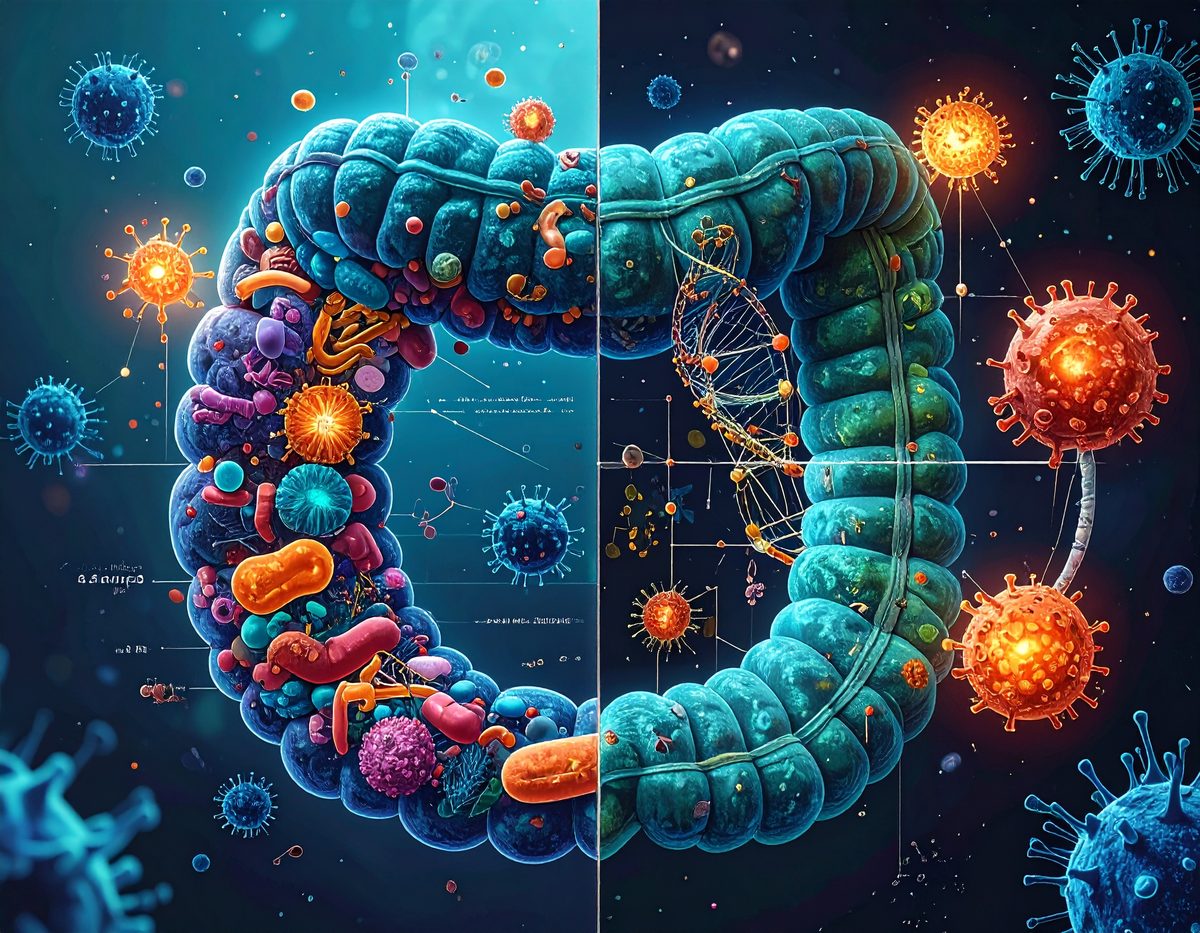
From insight to daily practice — five episodes about measuring, understanding and acting.
- S12·E1 — From a single test to a whole story
- S12·E2 — Multi-omics: the film instead of the photo
- S12·E3 — Why the same advice doesn't work for everyone
- S12·E4 — Measure, understand, adjust
- S12·E5 — Prevention as a lifestyle
Related concepts
Explore further in the Cosmogroup ecosystem
From knowledge to application — choose your next step.
My InnerSelfie
Reveal where your gut sensitivity comes from: predisposition, microbiome and metabolites together.
Discover My InnerSelfie →My Key Nutrients
Support gut balance in a targeted way: fibers and biotics tuned to your microbial signature.
See the range →CosmoPulse
For well-being and resilience: gut signals translated into practical choices.
Discover CosmoPulse →The books · HOST · FORMULA · EDGE
The common thread of this science, from insight to daily application, by Petra Van Gucht.
See the books →Scientific references
• Caruso R., Lo BC., Núñez G. (2020) — Host–microbiota interactions in immunity and inflammation. Nat Rev Immunol.
• Wlodarska et al. (2015) — An integrative view of microbiome–host interactions. Cell Host & Microbe.
• Van Gucht P. — HOST (COSMO trilogy): the disturbed dialogue behind gut complaints.
Frequently asked questions
- Is irritable bowel a real condition?
- Yes. IBS is a functional disorder without structural inflammation, but with real mechanisms: predisposition, microbiome and environment act together.
- What is the difference with Crohn's disease or colitis?
- Crohn's and colitis (IBD) are chronic inflammatory diseases with structural abnormalities; IBS produces no clear inflammation, but does share mechanisms.
- Why do I get complaints and my partner doesn't from the same food?
- Because sensitivity is co-metabolic: genetic vulnerability, microbial balance and lifestyle differ from person to person.
- Can I map the cause?
- Yes, by reading DNA, microbiome and metabolites together it becomes visible where the sensitivity comes from. This is supportive, not a diagnosis.
Hooked on co-metabolism?
You've just read one piece of the puzzle. There is a path for the curious who want to understand themselves better — and a deeper library for the professional who works with it.
Discover your own story
Curious what co-metabolism means for you? Discover what your own body tries to tell you every day — and stay up to date with new insights.
Discover your analysis →Join us and get access
Become an affiliated healthcare professional and unlock the depth we reserve for our partners: the books to read online, the Well@Work and Sport experiences, the protocols and a network of like-minded people.
Join us →