
Cobiotics & the biotics families
In plain language
The shelves are overflowing with “biotics”: pre-, pro-, post-, syn- and nowadays also cobiotics. Each of them is presented as the miracle cure for a better gut and a longer life. But what do those words actually mean? Prebiotics are fibers that feed certain bacteria. Probiotics are living bacteria that you add. Postbiotics are the useful substances that bacteria make themselves, such as butyrate. Synbiotics combine pre- and probiotics. And cobiotics, the newest generation, targets several connections at once.
The honest answer to the miracle-cure promise is sober: the effect of every biotics family depends on your own microbiome and predisposition. The same fiber or strain works beautifully in one person and barely at all in another. That is why the question is not “which biotic is the best?”, but “which one suits this body, at this moment?”. This shifts the story from hype on a package to something that fits how your system works.
The science behind
The biotics families form a historically grown series. Prebiotics are fermentable fibers that selectively feed useful bacteria; research into non-starch polysaccharides describes how they influence weight and metabolic health via the gut–adipose-tissue axis. Probiotics are living micro-organisms whose effect is strongly person-dependent: reviews show that they can modulate neuro-immunological routes, but often only in specific subgroups. Postbiotics — microbial metabolites such as short-chain fatty acids — can support immune regulation, and synbiotics combine pre- and probiotics so that they reinforce each other.
Cobiotics builds on this by deliberately acting on several crosstalk networks at once, rather than a single lever. That ties in with the insight that health rarely turns on one button: the gut talks simultaneously with brain, muscles, immune system and metabolism. Publications on microbiome and aging (including in Microbial Pathogenesis and related journals) describe how a depleted microbiome produces fewer short-chain fatty acids and more pro-inflammatory metabolites — a pattern that is associated with sarcopenia, inflammaging and cognitive decline. Biotics that support several axes at once align conceptually with that network logic.
The common thread is co-metabolism: whether a biotics strategy takes hold arises from the interplay of DNA, microbiome, metabolites and lifestyle together. Gene variants color the predisposition — which bacteria thrive, how fibers are fermented — but nutrition, rhythm and recovery determine what actually happens. That is why the difference between calendar age and biological age is partly a question of how well this network works together. In this reading, biotics are not miracle cures, but levers that only pay off when they suit the individual system. This reading is supportive and observational — not a medical diagnosis.
Illustration & CosmoTalks
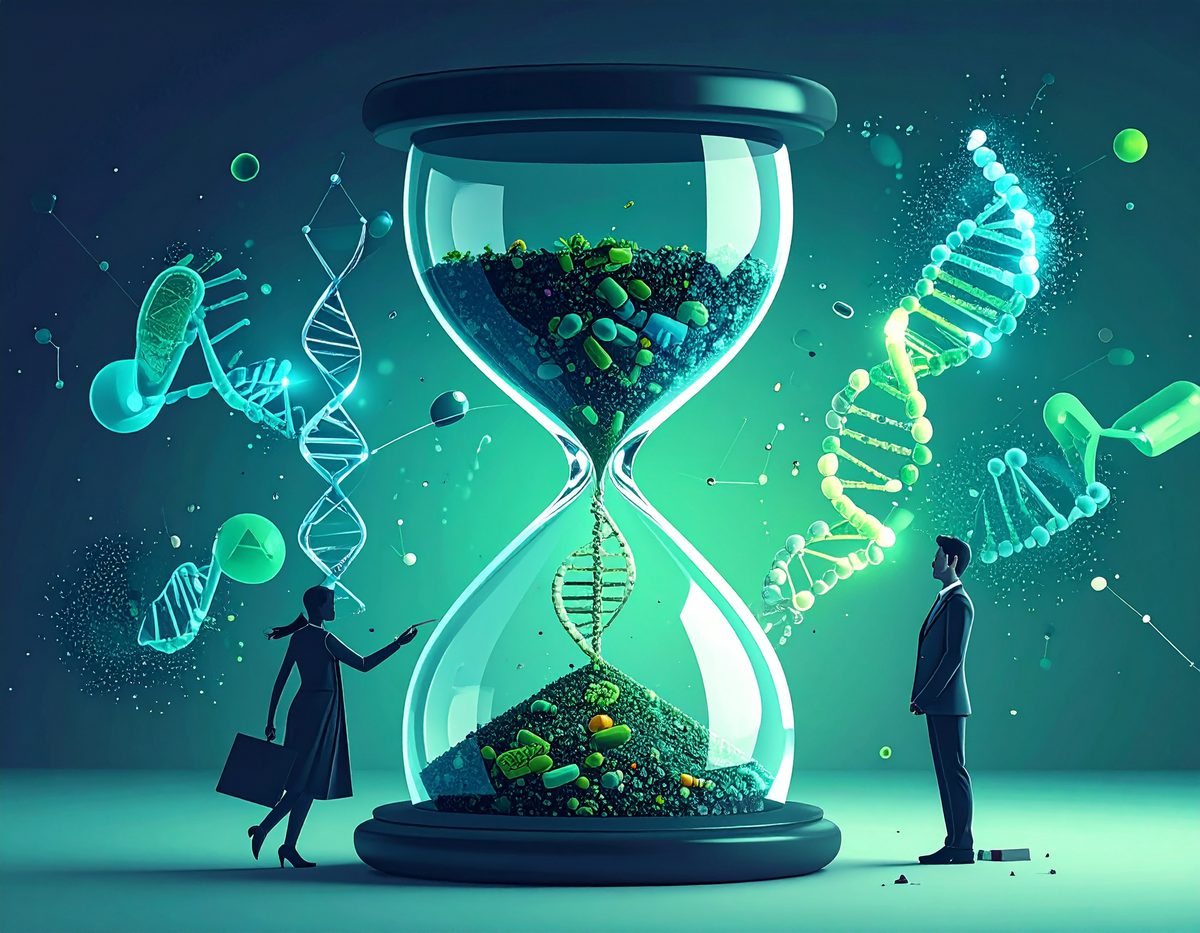
Why calendar age and biological age are not the same — and how your microbiome ages along with you — in five episodes.
- S10·E1 — Calendar age versus biological age
- S10·E2 — Inflammaging: aging as silent inflammation
- S10·E3 — An aging microbiome
- S10·E4 — Preserving energy, year after year
- S10·E5 — Staying vital into old age
Related concepts
Explore further in the Cosmogroup ecosystem
From knowledge to application — choose your next step.
My InnerSelfie
See which biotics families suit your microbiome and predisposition — DNA, microbiome and metabolome brought together into a readable picture.
Discover My InnerSelfie →My Key Nutrients
Targeted support instead of generic supplements: tuned to your co-metabolism, not to a hype.
View the range →CosmoPulse
For performance environments: readiness, adaptation and recovery bundled into one readable decision signal.
Discover CosmoPulse →The books · HOST · FORMULA · EDGE
The common thread of this science, from insight to everyday application, by Petra Van Gucht.
See the books →Scientific references
• Salminen S., et al. (2021) — Definition and scope of postbiotics. Nature Reviews Gastroenterology & Hepatology.
• Ghosh T.S., et al. (2022) — The gut microbiome as a modulator of healthy aging. Nature Reviews Gastroenterology & Hepatology.
• Van Gucht P. — HOST (COSMO trilogy): living together with your microbiome and the biotics families.
Frequently asked questions
- What is the difference between pre-, pro-, post- and synbiotics?
- Prebiotics are fibers that feed bacteria, probiotics are living bacteria, postbiotics are the useful substances that bacteria make (such as butyrate), and synbiotics combine pre- and probiotics.
- What makes cobiotics different?
- Cobiotics targets several components and crosstalk networks at once — for example gut–brain and gut–muscle — instead of a single lever.
- Do biotics work equally well for everyone?
- No. The effect depends strongly on your own microbiome and predisposition; the same strain or fiber can work in one person and barely at all in another.
- Can biotics slow down aging?
- They can support the balance, but are not a miracle cure. The difference between calendar and biological age arises from the interplay of DNA, microbiome, metabolites and lifestyle.
Hooked on co-metabolism?
You have just read one piece of the puzzle. There is a path for the curious who want to understand themselves better — and a deeper library for the professional who works with it.
Discover your own story
Curious what co-metabolism means for you? Discover what your own body is trying to tell you every day — and stay up to date with new insights.
Discover your analysis →Join us and gain access
Become an affiliated healthcare professional and unlock the depth we reserve for our partners: the books to read online, the Well@Work and Sport experiences, the protocols and a network of like-minded peers.
Join us →