
Brain fog in long COVID
In plain language
A 39-year-old consultant seems to recover well from a COVID infection. Yet the complaints remain: concentration problems, memory loss and brain fog. Meetings drain them, reading feels like a marathon. Why does the fog lift quickly for one person and linger for months in another? The answer lies in the crosstalk between the immune system, microbiome and neurotransmitters. Brain fog is therefore not a character flaw or something imagined, but a signal you can understand — and whose underlying factors you can make visible.
The science behind
After an infection, a subtle, persistent inflammation in the brain (neuro-inflammation) can disrupt signal conduction, which translates into slow thinking and reduced focus. At the same time, in many people the gut flora shifts (dysbiosis), so that fewer building blocks for serotonin and GABA are available — neurotransmitters that carry mood and mental calm.
On top of that, the stress axis often stays dysregulated: elevated cortisol levels worsen sleep quality, which further slows recovery. Research describes how host–microbiome interactions contribute to prolonged inflammation after COVID, and how the gut–brain axis influences cognitive recovery via serotonin and tryptophan pathways.
It explains why recovery is so personal: the outcome depends on the interplay between immune profile, microbiome, metabolites and lifestyle — the co-metabolism — and not on one factor alone. This reading is supportive and observational — not a medical diagnosis.
Illustration & CosmoTalks
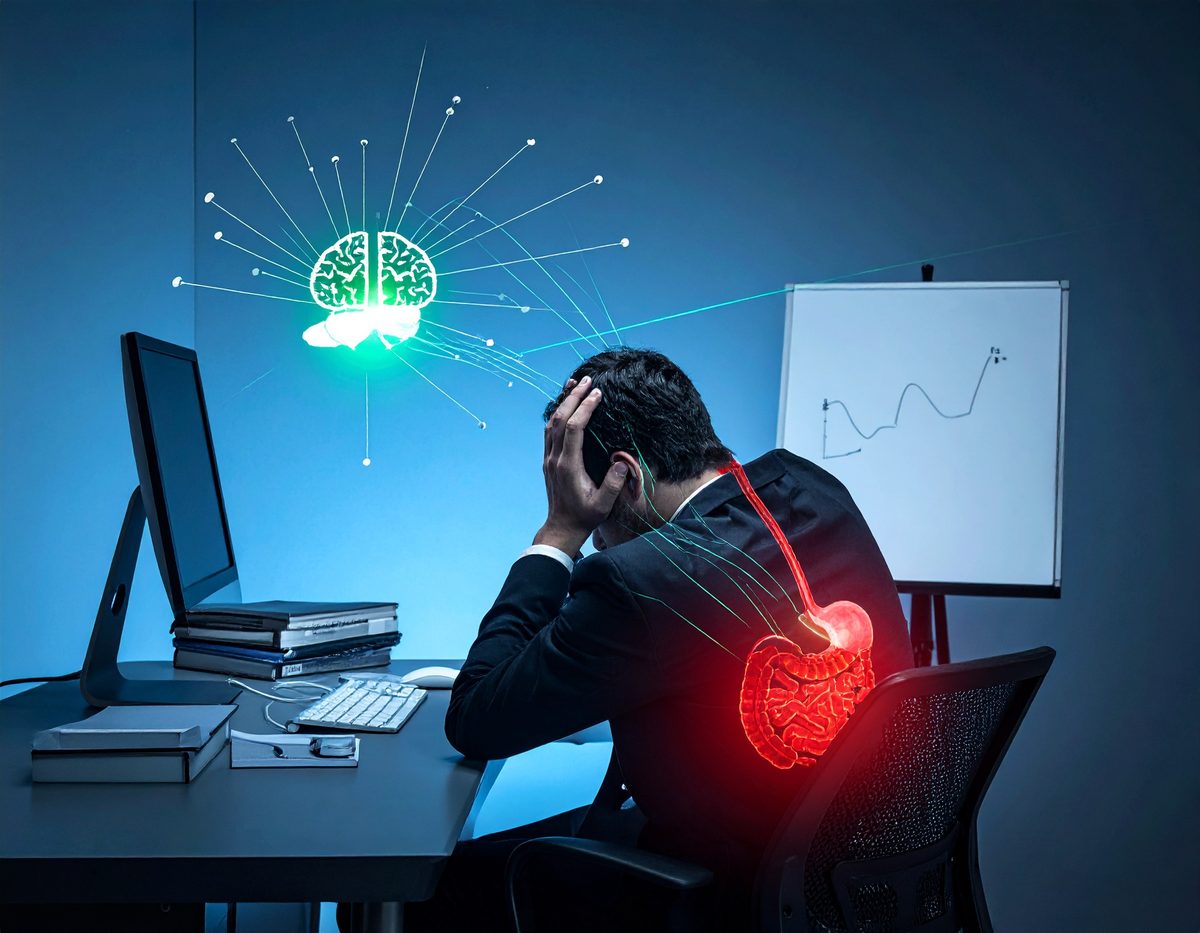
How your gut steers your mood and stress, in five short episodes.
- S3·E1 — Why mood is not only in your head
- S3·E2 — Your morning mood is not a character trait
- S3·E3 — Why stress hits your digestion first
- S3·E4 — Your microbiome has a day–night rhythm
- S3·E5 — Emotions are metabolic events
Related concepts
Explore further in the Cosmogroup ecosystem
From knowledge to application — choose your next step.
My InnerSelfie
Make visible which inflammation and stress profiles feed brain fog, and translate that into recovery-focused steps.
Discover My InnerSelfie →My Key Nutrients
Support recovery via anti-inflammatory nutrition, SCFA postbiotics and a tryptophan rhythm.
View the range →CosmoPulse
For recovery and return-to-work pathways: load capacity and readiness as a readable signal.
Discover CosmoPulse →The books · HOST · FORMULA · EDGE
The common thread of this science, from insight to everyday application, by Petra Van Gucht.
See the books →Scientific references
• Doenyas C., Clarke G. (2021) — Gut–brain axis and cognitive resilience. Front Neurosci.
• Taquet M., et al. (2022) — Neurological sequelae of COVID-19. Lancet Neurol.
Frequently asked questions
- Is brain fog in long COVID imaginary?
- No. It is biologically explainable via neuro-inflammation, a dysregulated gut–brain axis and a heightened stress response.
- Why does one person recover faster than another?
- Because recovery depends on the interplay between immune profile, microbiome, metabolites and lifestyle — and that differs from person to person.
- What does my gut have to do with my concentration?
- Your gut flora supplies building blocks for serotonin and GABA and produces anti-inflammatory substances; if that balance shifts, you notice it in focus and memory.
- Can I map these factors?
- Yes, a multi-omics analysis makes the inflammation, microbiome and stress signals visible and translates them into personal steps. This is supportive, not a diagnosis.