Host & symbiosis
In plain language
“Host” is simply you: the host with whom trillions of micro-organisms are guests. How smoothly that living-together runs varies from moment to moment. It helps to capture that in three recognizable zones. In symbioticus the team runs smoothly: balance, comfort, resilience. In modernicus the balance starts to shift — often through a modern lifestyle with too little fiber, too much stress or too little sleep. In dysbioticus the balance is really in motion and calls for attention.
These zones are not a diagnosis and not a fixed label. They work like a pair of reading glasses: a way to understand where you stand today and which direction of support fits. The goal is not “a perfect microbiome”, but recognizing in which direction your balance is moving — so that nutrition, sleep, exercise and targeted support can help the team back toward symbiosis.
The science behind
The terms build on a classic distinction from ecology: symbiosis (mutualistic living-together, in which host and microbes mutually support each other) versus dysbiosis (a disturbed microbial composition or function). Reviews in Nature and Cell Host & Microbe describe dysbiosis not as a binary “sick/healthy” switch, but as a spectrum of compositional and functional changes. That same spectrum can be translated into three public zones that name the direction of the balance rather than a fixed endpoint.
What makes the balance shift is well documented. Nutrition — and especially fiber diversity — is one of the most powerful driving factors; work on the effect of plant diversity on microbial richness (described by Tim Spector and colleagues, among others) illustrates this. In addition, medication (particularly antibiotics), chronic stress, sleep deprivation and a disrupted day-night rhythm all weigh in. The microbiome is therefore not a fixed organ but a dynamic ecosystem that constantly responds to how you live.
The common thread is co-metabolism: whether someone moves toward symbioticus or dysbioticus arises from the interplay of DNA, microbiome, metabolites and lifestyle together. Gene variants color the predisposition in the background, but nutrition, rhythm and recovery determine which way the balance tips. The three zones are therefore not labels stuck onto you, but a snapshot of a dynamic system — and it is precisely that dynamism that makes adjustment possible. This reading is supportive and observational — not a medical diagnosis.
Illustration & CosmoTalks
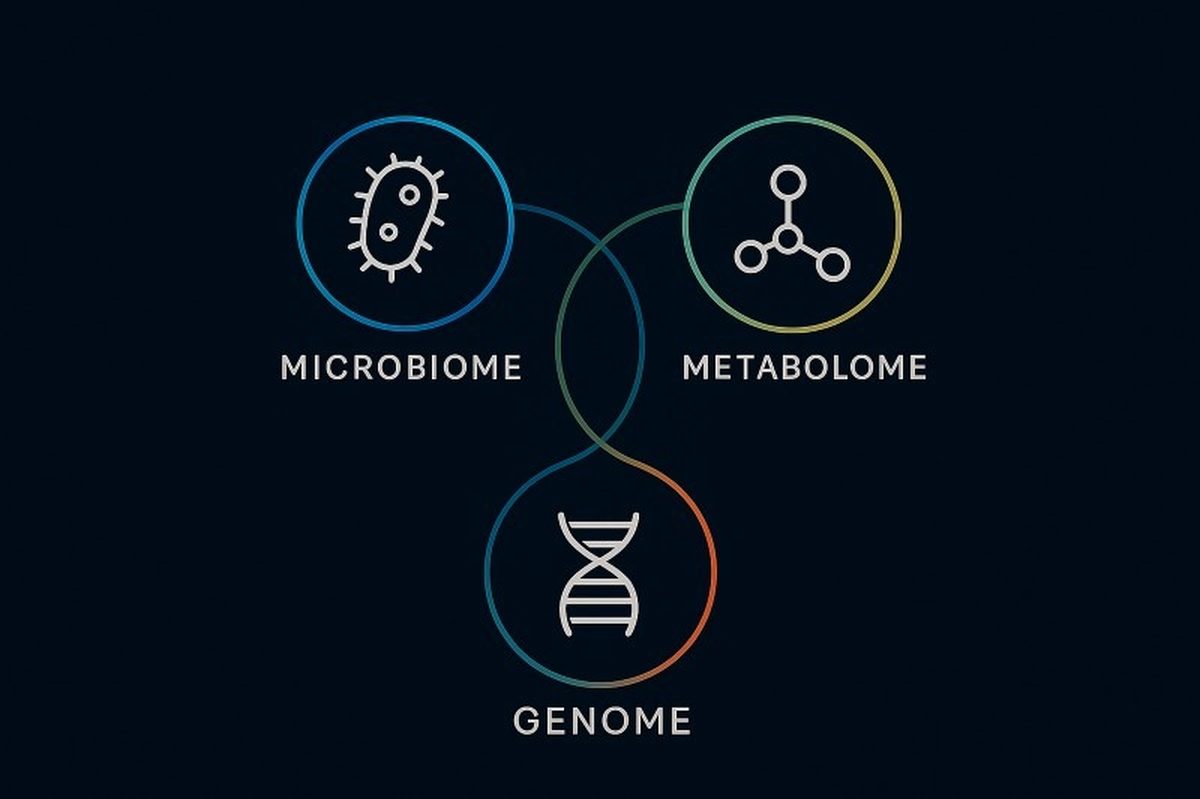
You and your microbes as one ecosystem — in five short episodes on collaboration in your body.
- S1·E1 — You are never alone: the idea of the holobiont
- S1·E2 — Crosstalk: how cells and microbes talk to each other
- S1·E3 — Who feeds whom? Symbiosis in the gut
- S1·E4 — When the conversation stalls: dysbiosis
- S1·E5 — One ecosystem, one health
Related concepts
Explore further in the Cosmogroup ecosystem
From knowledge to application — choose your next step.
My InnerSelfie
See where your host-microbiome balance stands today — DNA, microbiome and metabolome brought together into a readable picture.
Discover My InnerSelfie →My Key Nutrients
Support tailored to your direction: from maintaining balance to rebuilding when the balance shifts.
See the range →CosmoPulse
For performance environments: readiness, adaptation and recovery bundled into one readable decision signal.
Discover CosmoPulse →The books · HOST · FORMULA · EDGE
The common thread of this science, from insight to everyday application, by Petra Van Gucht.
See the books →Scientific references
• Levy M., et al. (2017) — Dysbiosis and the immune system. Nature Reviews Immunology.
• Spector T. (2015) — The Diet Myth. (popular-science overview of microbiome & nutrition).
• Van Gucht P. — HOST (COSMO trilogy): the host profiles and living together with your microbiome.
Frequently asked questions
- What is a “host”?
- You, the host with whom your micro-organisms are guests. Together you form one ecosystem, also called the holobiont.
- What does dysbiosis mean?
- A shift in the composition or function of the microbiome, away from the healthy balance. It is a spectrum, not an on/off switch.
- Are the three zones a diagnosis?
- No. They are educational zones to understand the direction of your balance — not a medical diagnosis or treatment.
- Can I move from dysbioticus back to symbioticus?
- The balance is dynamic. Nutrition (especially fiber diversity), sleep, exercise and targeted support can help steer it back in the right direction.
Hooked on co-metabolism?
You've just read one piece of the puzzle. There's a path for the curious who want to understand themselves better — and a deeper library for the professional who works with it.
Discover your own story
Curious what co-metabolism means for you? Discover what your own body is trying to tell you every day — and stay up to date with new insights.
Discover your analysis →Join us and gain access
Become an affiliated healthcare professional and unlock the depth we reserve for our partners: the books to read online, the Well@Work and Sport experiences, the protocols and a network of like-minded peers.
Join us →