
Microbiome & sports performance
In plain language
A top performance is no accident: it is finely tuned training, nutrition and recovery. But behind the muscles lies a second arena. Your microbiome and your metabolism also adapt to the training load. Those who build up progressively cultivate bacteria that recycle lactate and amino acids more efficiently; those who overload without recovery lose exactly that flexibility.
As a result, not all athletes gain the same benefit from the same schedule. One adapts smoothly, another stalls or gets injured. Muscle tissue and gut turn out to communicate directly with each other, via protein breakdown, bile acids and inflammatory signals. Understand that dialogue and it becomes visible whether someone is under-, optimally or over-adapting — and you can fine-tune training, nutrition and recovery more precisely instead of blindly following “train harder, more carbohydrates”.
The science behind
Intensive training cycles change the microbiome not only in composition but also in functional capacity — energy production and stress resistance (among others BMC Microbiome, 2023). With progressive load, bacteria increase that recycle lactate and amino acids more efficiently; with overload without recovery that flexibility declines, which goes hand in hand with metabolic “rigidity” and higher injury risk. The microbiome thus carries a measurable “training imprint”.
The communication runs in two directions. Muscle tissue and microbiome influence each other via amino acid turnover (relevant for recovery and hypertrophy), via bile acid modulation that feeds back onto mitochondria in the muscle, and via post-exercise metabolites such as indoles that steer the inflammatory sensitivity of tissue. Research into host-microbiome crosstalk describes how these signals determine whether a training stimulus leads to adaptation or to damage. That explains why the same load yields progress in one athlete and stagnation in another.
The common thread is co-metabolism: training response arises from the interplay of DNA (predisposition for muscle fiber type, connective tissue and antioxidant capacity), microbiome, metabolites and lifestyle (load, nutrition, recovery) together. Gene variants color the predisposition; the gut-muscle dialogue and lifestyle determine what you do with it. Measuring across multiple layers at once makes it possible to steer adaptation in time. This reading is supportive and observational — not a medical diagnosis.
Illustration & CosmoTalks
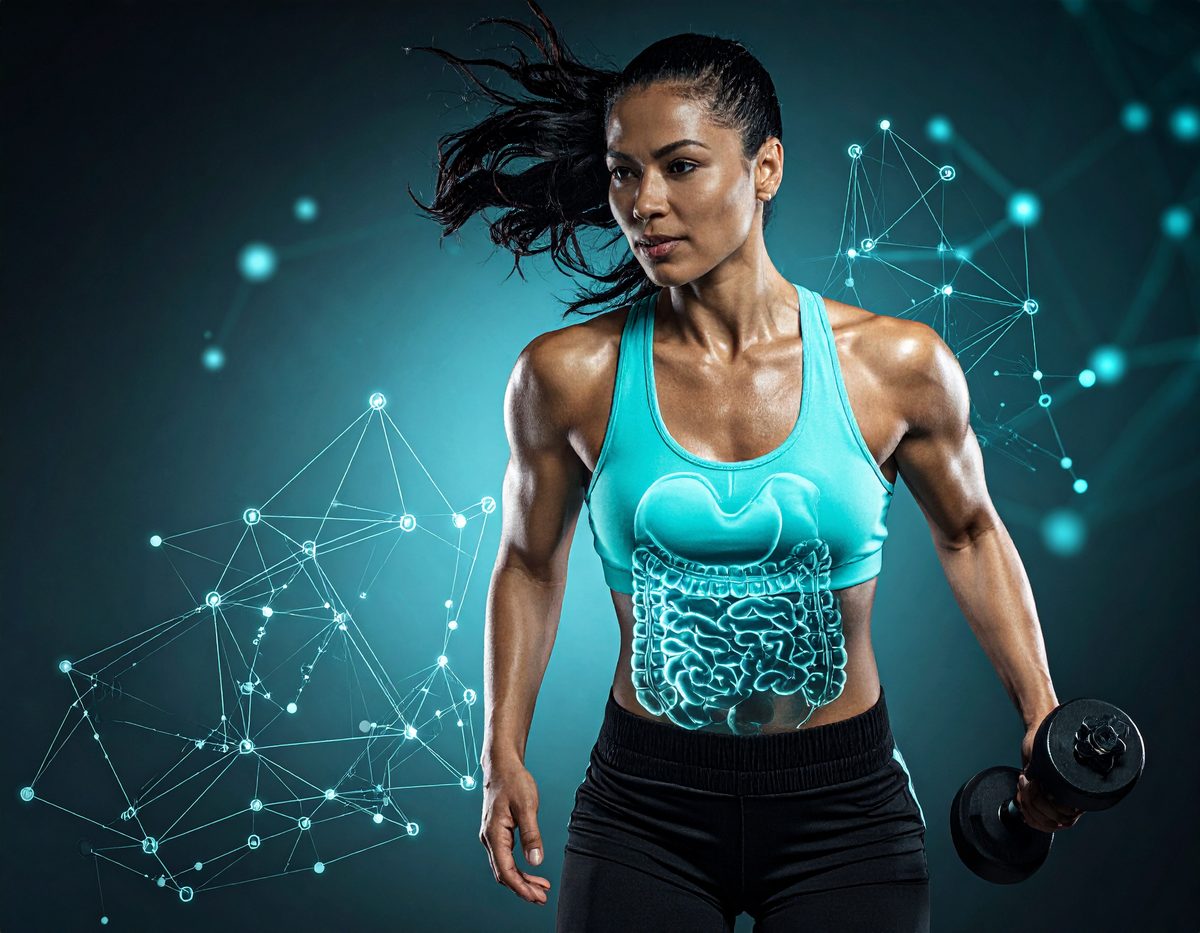
How your microbiome moves along with training, recovery and performance — five episodes.
- S4·E1 — Your gut trains too
- S4·E2 — Nutrition as fuel and as a signal
- S4·E3 — Why one athlete recovers faster
- S4·E4 — Inflammation: ally and saboteur
- S4·E5 — Injuries often begin in the gut
Related concepts
Explore further in the Cosmogroup ecosystem
From knowledge to application — choose your next step.
My InnerSelfie
See whether you are under-, optimally or over-adapting: DNA, microbiome and metabolites together as a training compass.
Discover My InnerSelfie →My Key Nutrients
Support recovery and adaptation with targeted nutrition and timing, tailored to your co-metabolism.
See the range →CosmoPulse
For performance settings: readiness, adaptation and recovery bundled into one readable decision signal.
Discover CosmoPulse →The books · HOST · FORMULA · EDGE
The common thread of this science, from insight to everyday application, by Petra Van Gucht.
See the books →Scientific references
• Clarke SF., et al. (2014) — Exercise and associated dietary extremes impact gut microbial diversity. Gut.
• Scheiman J., et al. (2019) — Meta-omics analysis of elite athletes. Nature Medicine.
• Van Gucht P. — EDGE (COSMO trilogy): training, recovery and the gut-muscle dialogue.
Frequently asked questions
- Can training change my microbiome?
- Yes. Exercise changes both the composition and the function of your gut flora. Progressive build-up with recovery promotes a flexible, adaptive microbiome.
- Why does the same schedule not work for everyone?
- Because training response depends on DNA, microbiome and recovery together. One athlete adapts smoothly, another over- or under-adapts.
- What is the gut-muscle axis?
- The two-way communication between muscle tissue and microbiome via metabolites and bile acids, which helps steer muscle recovery and adaptation.
- How do I fine-tune my training?
- By looking at multiple layers — load, recovery, nutrition and biological response — and adjusting in time. This is supportive, not medical advice.
Bitten by co-metabolism?
You have just read one piece of the puzzle. There is a path for the curious who want to understand themselves better — and a deeper library for the professional who works with it.
Discover your own story
Curious what co-metabolism means for you? Discover what your own body tries to tell you every day — and stay up to date with new insights.
Discover your analysis →Join us and gain access
Become an affiliated healthcare professional and unlock the depth we reserve for our partners: the books to read online, the Well@Work and Sport experiences, the protocols and a network of like-minded people.
Join us →