
Restlessness & rumination
In plain language
A 28-year-old man lies in bed at night, but his thoughts keep racing. During the day he often feels an inner restlessness, even without a clear reason. Classic tips such as breathing or mindfulness only help to a limited extent. Why does his brain keep spinning in fifth gear? The answer lies in the crosstalk between stress hormones, the microbiome and neurotransmitters. Rumination and restlessness are therefore not a matter of willpower, but the result of biological signals that are out of balance — signals you can make visible and steerable.
The science behind
With persistent restlessness, the stress axis is often permanently “switched on”: elevated cortisol makes genuine relaxation difficult. At the same time, a disrupted gut-brain axis (dysbiosis) lowers the production of serotonin and GABA, precisely the neurotransmitters that bring calm and quiet.
A third player is histamine. Mast cell activation and histamine spikes intensify restlessness and night-time waking, and in this way affect both sleep and mood. Research links stress hormones and microbiome imbalance to anxiety and ruminative behavior, and describes the role of histamine and mast cells in insomnia.
As always with the gut-brain axis: the outcome is co-metabolic. Whether someone settles down depends on the interplay between cortisol, the microbiome, histamine balance and lifestyle — not on a single switch. That is why general advice does not work for everyone. This reading is supportive and observational — not a medical diagnosis.
Illustration & CosmoTalks
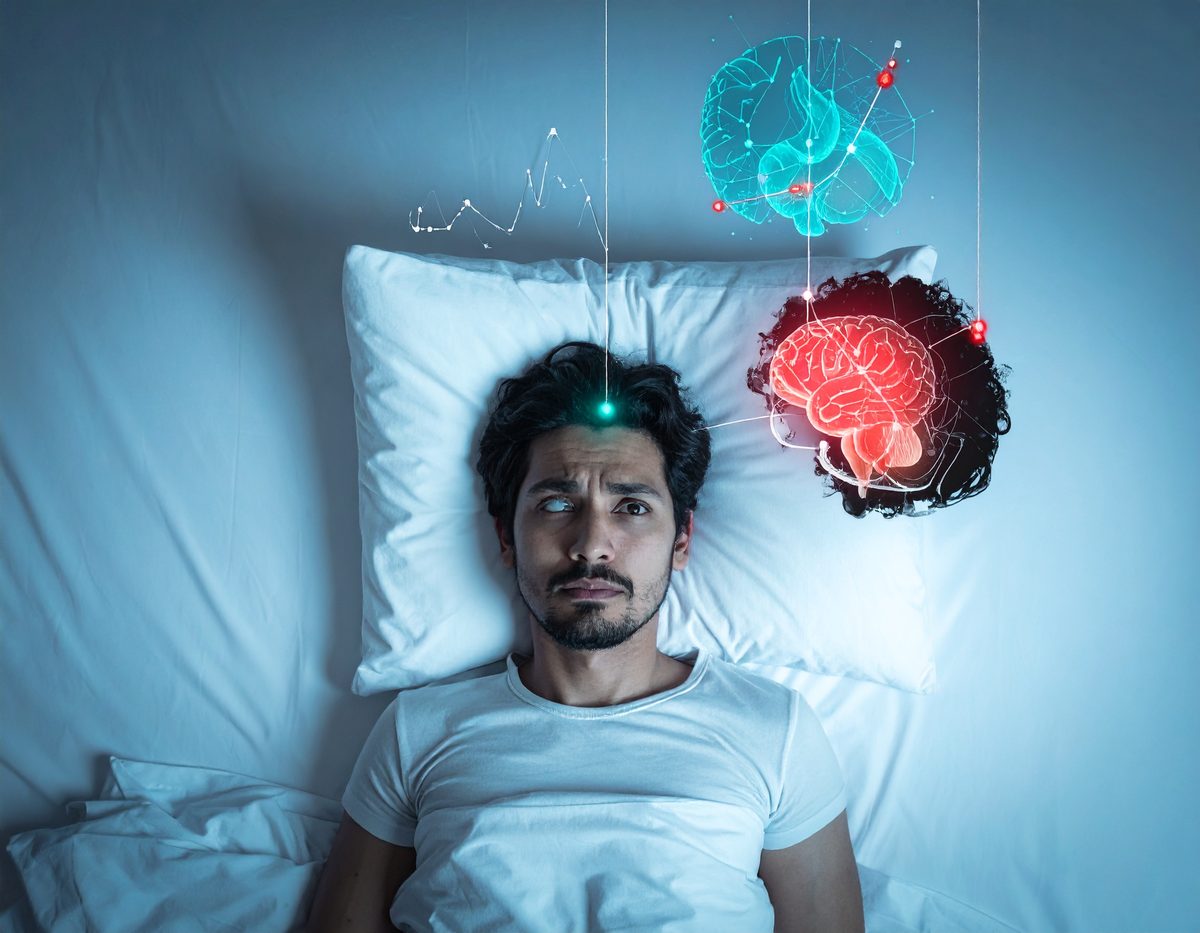
How your gut steers your mood and stress, in five short episodes.
- S3·E1 — Why mood is not only in your head
- S3·E2 — Your morning mood is not a character trait
- S3·E3 — Why stress hits your digestion first
- S3·E4 — Your microbiome has a day-night rhythm
- S3·E5 — Emotions are metabolic events
Related concepts
Explore further in the Cosmogroup ecosystem
From knowledge to application — choose your next step.
My InnerSelfie
Make visible how stress profiles, the microbiome and neurotransmitters feed your restlessness — and which patterns intensify rumination.
Discover My InnerSelfie →My Key Nutrients
Support calm and sleep: GABA- and serotonin-friendly nutrition, a tryptophan rhythm and histamine-aware choices.
See the range →CosmoPulse
For recovery and sleep: night-time load and readiness as a readable signal.
Discover CosmoPulse →The books · HOST · FORMULA · EDGE
The common thread of this science, from insight to everyday application, by Petra Van Gucht.
See the books →Scientific references
• Foster JA., McVey Neufeld KA. (2020) — Gut–brain axis and neurotransmitters. Brain Behav Immun.
• Chiu IM., et al. (2022) — Mast cells and histamine in anxiety and sleep disturbance. Front Immunol.
Frequently asked questions
- Is rumination a character flaw?
- No. It is a biologically influenced state in which cortisol, the microbiome and histamine suppress calming neurotransmitters.
- Why do breathing or mindfulness only help to a limited extent?
- Because the underlying biology — stress hormones, the microbiome and histamine — does not shift on its own. Addressing those factors as well is what makes the difference.
- What does histamine have to do with restlessness?
- Mast cell activation and histamine spikes intensify restlessness and night-time waking, and in this way act on both sleep and mood.
- Can I map out these factors?
- Yes, a multi-omics analysis makes the stress, microbiome and histamine signals visible and translates them into personal steps. This is supportive, not a diagnosis.