
Post-infectious syndromes
In plain language
Many people do not recover fully after an infection. The fever is gone, the test is negative, and yet the body stays stuck: persistent fatigue, muscle pain, a foggy head, a resistance that just will not come back. Classic tests then often show nothing, so the complaints are dismissed as “residual symptoms” or “psychological” — frustrating for doctor én patient alike. Yet they are biologically explainable. After an infection the immune system can remain in a mild, persistent state of alarm, the power stations of your cells (mitochondria) can work less efficiently, and the microbiome falls out of balance. Those three processes reinforce one another. That explains why recovery is so personal: it does not hang on one single cause, but on an interplay that in one person recovers smoothly and in another keeps reverberating.
The science behind
Research using multi-omics shows that post-infectious complaints go hand in hand with lasting immune activation. In Lyme disease the immune response turns out to run differently per tissue or compartment, which means classic blood markers often fail to capture the complaints. In post-COVID, low-grade, persistent inflammation is described — among other things via IL-6 and TNFα pathways — that is also measurable when the standard values look normal. This silent activation helps explain why fatigue and muscle pain do not disappear once the infection is over.
A second layer is mitochondrial dysfunction. After an infection has been overcome, the power stations of the cell can produce ATP less efficiently, which shows up as exhaustion and slow recuperation. Metabolite profiles (ATP, lactate, amino-acid pathways) make that energy deficit more objectively visible. At the same time the microbiome plays a part: post-infectious dysbiosis keeps the inflammatory tone high and becomes interwoven with the classic crosstalk axes — gut–lung after pneumonia, gut–heart after myocarditis, gut–brain in brain fog after EBV or COVID. AI-driven analyses of combined datasets also distinguish subtypes of patients with mainly metabolic, inflammatory or cognitive vulnerability.
The common thread is co-metabolism: whether someone recovers smoothly or stays stuck arises from the interplay of DNA, microbiome, metabolites and lifestyle together — not from one gene or one bacterium. Gene variants shade the sensitivity in the background, but it is the whole that determines how recovery unfolds. This reading is supportive and observational — not a medical diagnosis.
Illustration & CosmoTalks
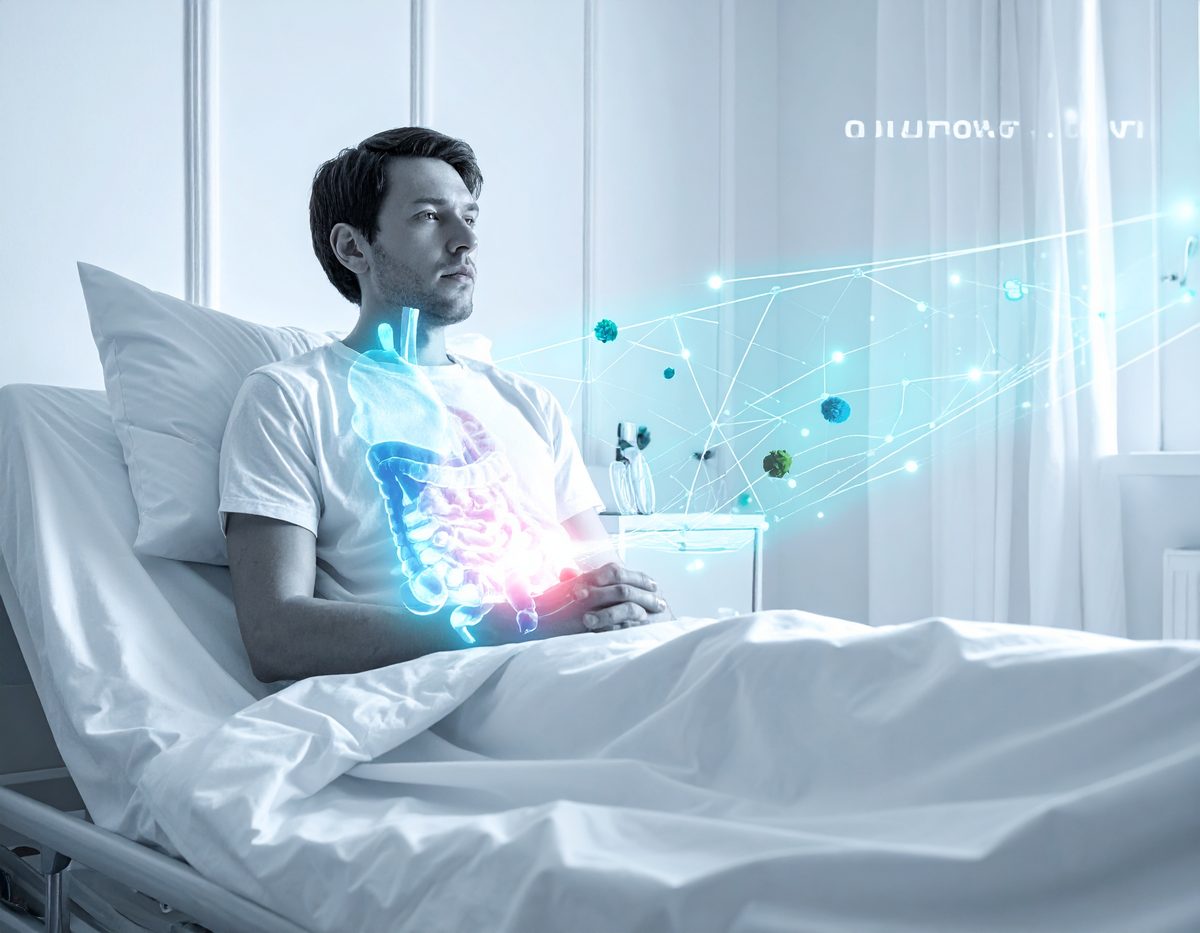
How your body adapts under pressure — five episodes on energy and adaptation.
- S6·E1 — Not more energy, but handling energy more cleverly
- S6·E2 — Mitochondria and microbes: the engine behind your day
- S6·E3 — Where energy leaks away: inflammation and stress
- S6·E4 — Adaptation in shift work and under load
- S6·E5 — Resilience as a trainable trait
Related concepts
Explore further in the Cosmogroup ecosystem
From knowledge to application — choose your next step.
My InnerSelfie
Make the hidden layer after an infection visible: immune activation, energy metabolism and microbiome together, translated into readable signals.
Discover My InnerSelfie →My Key Nutrients
Support recovery and resistance from within: inflammation-aware, energy-supporting nutrition and formulas tailored to your co-metabolism.
See the range →CosmoPulse
For performance environments: readiness, adaptation and recovery bundled into one readable decision signal.
Discover CosmoPulse →The books · HOST · FORMULA · EDGE
The common thread of this science, from insight to daily application, by Petra Van Gucht.
See the books →Scientific references
• Ward C., Schlichtholz B. (2024) — Post-acute sequelae and mitochondrial aberration in SARS-CoV-2 infection. Int J Mol Sci.
• Xiong R., et al. (2025) — AI-driven multi-omics modeling of ME/CFS. Nature Medicine.
• Van Gucht P. — EDGE (COSMO trilogy): recovery as an interplay of human and microbiome.
Frequently asked questions
- What are post-infectious syndromes?
- Complaints that persist after an infection has been overcome — such as post-COVID, post-sepsis or post-Lyme — with fatigue, muscle pain, brain fog and low resistance, while standard testing often comes back normal.
- Why do my blood values show nothing?
- Classic markers often fail to capture the persistent, low-grade immune activation and the mitochondrial and microbial shifts. Multi-omics can make that hidden layer visible.
- Are these complaints “psychological”?
- No. They are biologically explainable through lasting immune activation, mitochondrial dysfunction and dysbiosis. They are simply missed too often by standard tests.
- Can I support my recovery?
- Often yes, through targeted nutrition, lifestyle and recovery tailored to your profile. This always happens alongside your medical care and is supportive, not a diagnosis.
Hooked on co-metabolism?
You have just read one piece of the puzzle. There is a path for the curious who want to understand themselves better — and a deeper library for the professional who works with it.
Discover your own story
Curious what co-metabolism means for yóu? Discover what your own body tries to tell you every day — and stay up to date with new insights.
Discover your analysis →Join us and gain access
Become an affiliated healthcare professional and unlock the depth we reserve for our partners: the books to read online, the Well@Work and Sport experiences, the protocols and a network of like-minded people.
Join us →