
Itchy scalp
In plain language
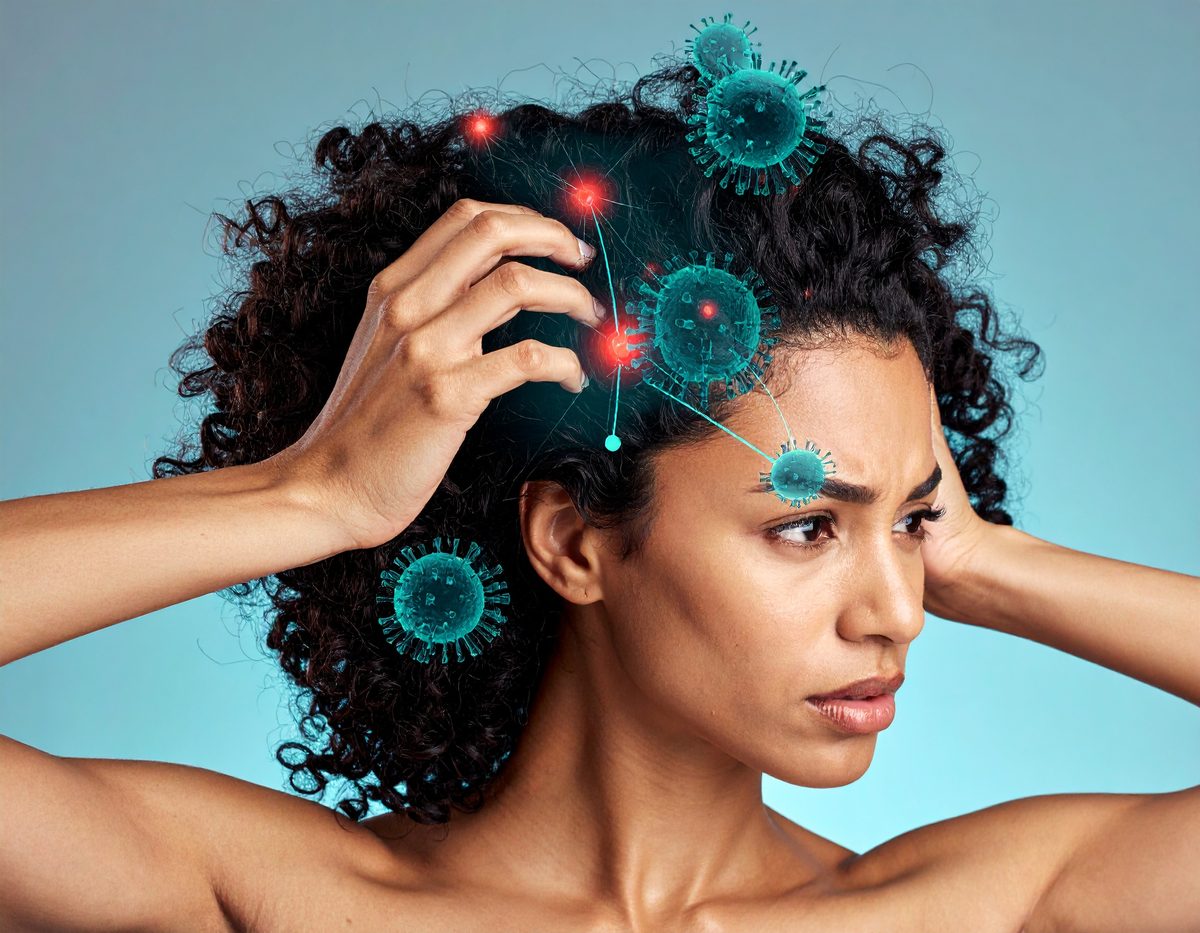
Months of scalp itch: anti-dandruff shampoo helps for a while, but the complaints return — sometimes flaking, sometimes redness, sometimes just unbearable itch. And often no one finds a clear abnormality. That makes it confusing. Yet there is more going on than “dry skin”. The scalp has its own microbiome, a fine balance of bacteria and yeasts, that works together with your immune system. If that balance becomes disturbed, mast cells can release histamine and thereby cause itching and redness. Stress and certain foods can raise that histamine load even further. And because scratching damages the skin barrier, the itch reinforces itself. This makes clear why scalp itch is rarely purely cosmetic — and why it only calms down once you also restore the underlying balance.
The science behind
Scalp itch (scalp pruritus) is generally multifactorial: overviews describe a role for both the immune system and the skin microbiome, rather than a single cause. Mast cells and histamine are central to the persistent character of chronic itch: mast cells in the skin release histamine when irritated, which triggers itching and redness. A disturbance of the skin microbiome — for example an overgrowth of Malassezia yeast in seborrhoeic dermatitis — can sustain that irritation.
The second layer is the gut-skin axis. Nutrition and the gut microbiome influence skin and scalp health: the composition of the gut flora helps steer how strongly the skin inflames and how much histamine is available. Stress adds to this, as it raises both the histamine load and the inflammatory tone. The scratching itself damages the skin barrier, allowing irritants to penetrate more easily and creating an itch-scratch cycle that sustains the complaints. In this way scalp itch is rarely a local, cosmetic problem, but an expression of a broader interplay.
The common thread is co-metabolism: whether scalp itch returns arises from the interplay of DNA, microbiome, metabolites (such as histamine) and lifestyle together. Genetic differences in skin barrier and histamine breakdown color sensitivity in the background, but the whole — flora, nutrition, stress and recovery — determines whether the skin calms down. This reading is supportive and observational — not a medical diagnosis.
Illustration & CosmoTalks
From insight to daily practice — five episodes on measuring, understanding and acting.
- S12·E1 — From a single test to the whole story
- S12·E2 — Multi-omics: the film instead of the photo
- S12·E3 — Why the same advice doesn't work for everyone
- S12·E4 — Measure, understand, adjust
- S12·E5 — Prevention as a lifestyle
Related concepts
Explore further in the Cosmogroup ecosystem
From knowledge to application — choose your next step.
My InnerSelfie
Make visible whether itch is linked to histamine peaks or mast cell activation, and how your microbiome influences skin and scalp.
Discover My InnerSelfie →My Key Nutrients
Support skin barrier and microbiome balance from within, with nutrition and formulas tailored to your co-metabolism.
See the range →CosmoPulse
For performance environments: readiness, adaptation and recovery bundled into one readable decision signal.
Discover CosmoPulse →The books · HOST · FORMULA · EDGE
The common thread of this science, from insight to everyday application, by Petra Van Gucht.
See the books →Scientific references
• Krajewski PK., et al. (2021) — Mast cells and histamine in chronic itch. Front Immunol.
• Fattah A., et al. (2022) — Gut–skin axis and dermatological health. Nutrients.
• Van Gucht P. — HOST (COSMO trilogy): the skin as a mirror of your ecosystem.
Frequently asked questions
- Why does anti-dandruff shampoo only help temporarily?
- Because the cause often does not lie at the surface: mast cell activation, histamine and a disturbed skin microbiome keep the itch going. Shampoo does not address that underlying interplay.
- Is scalp itch just dry skin?
- Not always. Scalp itch is often multifactorial, with a role for the immune system, mast cells and the skin microbiome — more than cosmetic discomfort.
- Can stress worsen my scalp itch?
- Yes. Stress raises both the histamine load and the inflammatory tone, which can flare up the itch.
- Does this replace a dermatologist?
- No. Persistent or severe complaints belong with your doctor. A multi-omics reading is supportive and observational, not a diagnosis.
Hooked on co-metabolism?
You've just read one piece of the puzzle. There's a path for the curious who want to understand themselves better — and a deeper library for the professional who works with it.
Discover your own story
Curious what co-metabolism means for you? Discover what your own body is trying to tell you every day — and stay up to date with new insights.
Discover your analysis →Join us and gain access
Become an affiliated healthcare professional and unlock the depth we reserve for our partners: the books to read online, the Well@Work and Sport experiences, the protocols and a network of like-minded peers.
Join us →