
Mast cells, sleep & nocturnal itch
In plain language
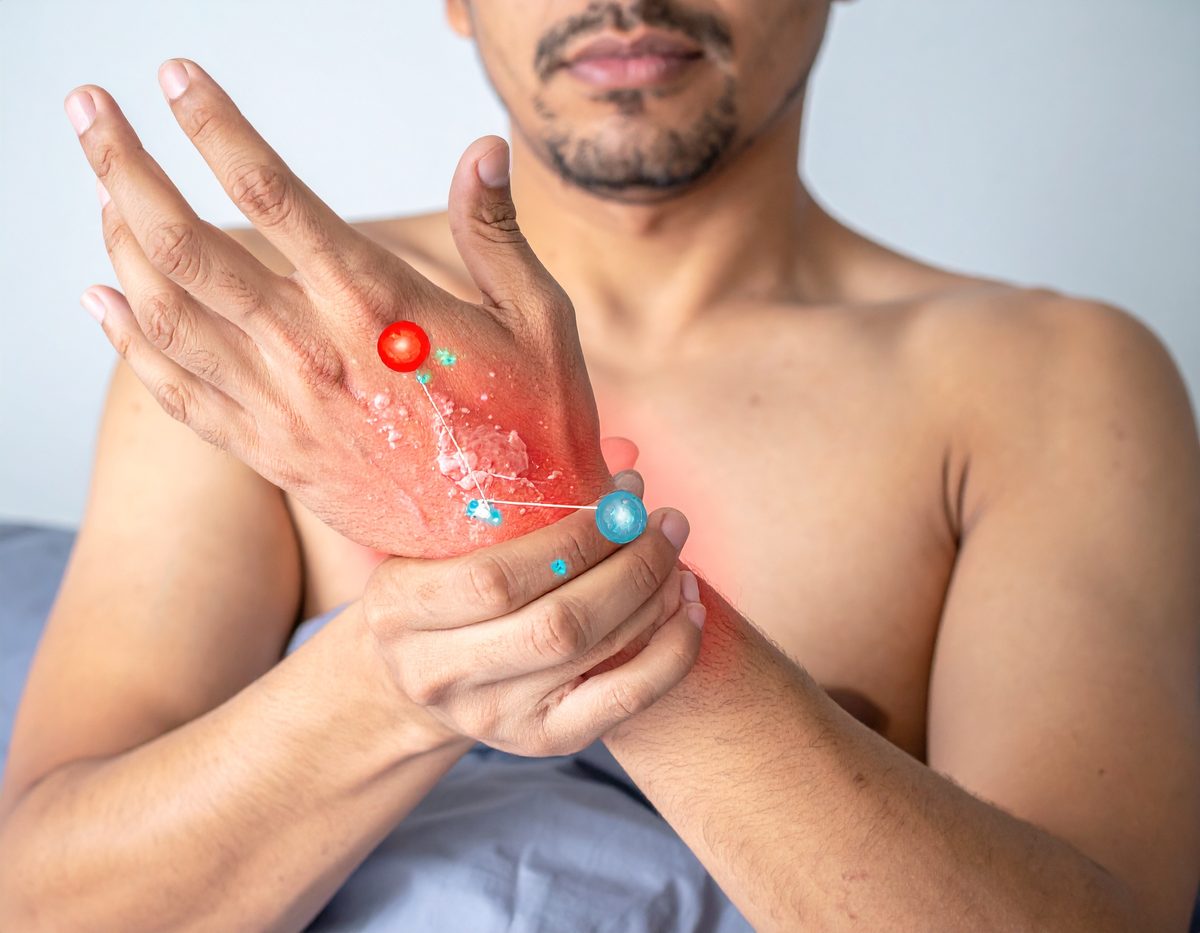
Someone wakes up around three in the morning with palpitations and itching, and during the day has eczema between the fingers. Creams help briefly, allergy tests are negative, and yet the complaints keep coming back. Why are sleep and skin connected? The answer lies with mast cells: immune cells in your skin and mucous membranes that release histamine. That release follows a day-night rhythm and is often higher at night. More histamine means more itching and more inflammation — precisely at the moment when you should be recovering. If on top of that your gut flora is out of balance, the histamine load rises even further. This makes it understandable why the skin stays irritated during the day and sleep is shallow at night: it is not coincidence, but a rhythm you can learn to recognize and support.
The science behind
Mast cells sit strategically in the skin, gut wall and airways, where they release histamine, tryptase and cytokines when stimulated. In the skin, mast cell activation contributes to eczema and to the nocturnal itch that is typical of atopic complaints. Research into mast cells in atopic dermatitis shows that this activation not only drives the itch, but also weakens the skin barrier, so that stimuli penetrate more easily and the inflammation feeds itself.
The timing is no coincidence. The immune system — and the histamine release by mast cells — follows a circadian rhythm. Several reviews describe how immune activity proceeds differently at night than during the day, with an increased tendency toward itching and inflammation in the late night. That explains the classic pattern of waking up with itching and palpitations. At the same time the gut-skin axis plays a role: the composition of the microbiome co-steers how much histamine is available and how strongly the skin inflames. Certain gut bacteria break down histamine, others produce it or block its breakdown — so a gut imbalance interweaves with skin and sleep complaints.
The common thread is co-metabolism: whether someone sleeps smoothly through the night or wakes up itching arises from the interplay of DNA, microbiome, metabolites (such as histamine) and lifestyle together. Gene variants in histamine breakdown color the sensitivity in the background, but it is the whole — rhythm, flora, nutrition and stress — that determines the pattern. This reading is supportive and observational — not a medical diagnosis.
Illustration & CosmoTalks
How your body recovers after strain, illness or too little sleep — five episodes.
- S8·E1 — Recovery is an active process, not a pause
- S8·E2 — Sleep as repair crew
- S8·E3 — Restarting the power plants
- S8·E4 — Why recovery differs for everyone
- S8·E5 — From exhaustion back to resilience
Related concepts
Explore further in the Cosmogroup ecosystem
From knowledge to application — choose your next step.
My InnerSelfie
Make the connection between gut, skin and sleep visible: DNA, microbiome and histamine balance together, translated into readable signals.
Discover My InnerSelfie →My Key Nutrients
Support a calm histamine balance from within: nutrition and formulas tuned to your co-metabolism, with attention to skin and recovery.
See the range →CosmoPulse
For performance environments: readiness, adaptation and recovery bundled into one readable decision signal.
Discover CosmoPulse →The books · HOST · FORMULA · EDGE
The common thread of this science, from insight to daily application, by Petra Van Gucht.
See the books →Scientific references
• Haspel JA., et al. (2020) — Circadian rhythms and immunity. NIH Workshop Summary.
• Di Ciaula A., et al. (2022) — Gut microbiota and histamine in skin health. Microorganisms.
• Van Gucht P. — HOST (COSMO trilogy): skin, sleep and gut as one ecosystem.
Frequently asked questions
- Why is the itch worse at night?
- Histamine release by mast cells follows a day-night rhythm and often peaks in the late night. As a result, itching and inflammation are felt more strongly at night.
- What does my gut have to do with my skin?
- Via the gut-skin axis your microbiome co-steers how much histamine is available and how strongly the skin inflames. Some bacteria break down histamine, others do not.
- My allergy test is negative — what now?
- Complaints can arise from mast cell activation or histamine intolerance without a classic allergy. These do not always show up on a standard allergy test.
- Can I do something about this myself?
- Often yes, via nutrition, rhythm, stress and recovery tuned to your profile. This is supportive and happens alongside your medical care, not in its place.
Bitten by co-metabolism?
You have just read one piece of the puzzle. There is a path for the curious who want to understand themselves better — and a deeper library for the professional who works with it.
Discover your own story
Curious what co-metabolism means for you? Discover what your own body tries to tell you every day — and stay up to date with new insights.
Discover your analysis →Join us and gain access
Become an affiliated healthcare professional and unlock the depth we reserve for our partners: the books to read online, the Well@Work and Sport experiences, the protocols and a network of like-minded people.
Join us →