
VO₂max & SCFAs
In plain language
In elite sport it comes down to fractions of a second. VO₂max — how much oxygen your body can take up and use at maximum — is regarded as the yardstick for endurance. For a long time it was thought to depend mainly on the heart, lungs and training. But there is a layer beneath that layer: your microbiome. Small molecules that gut bacteria make — the short-chain fatty acids, or SCFAs — turn out to help determine how efficiently your muscles handle oxygen.
The finest example is lactate. During heavy exertion lactate builds up and that feels like acidification. But certain gut bacteria break lactate down and convert it into propionate, an SCFA that muscles can use again as fuel. What is waste for the human being thus becomes energy for the microbiome — and comes back as fuel. That is crosstalk in action. Two people with the same lungs and the same heart can therefore still differ in endurance, depending on what their microbiome extracts from it.
The science behind
VO₂max is traditionally read as the interplay of lungs, heart and muscles. Research in Sports Medicine nuances that picture: microbial metabolites — in particular butyrate and propionate — contribute to oxygen efficiency in muscles because they support mitochondrial function. Muscles thus produce more energy per molecule of oxygen. Maximum oxygen uptake is therefore not only a matter of pumping power and lung capacity, but also of how well the microbiome contributes to energy metabolism.
A telling mechanism is lactate conversion. A widely cited meta-omics study in Nature Medicine found that endurance athletes harbor more lactate-utilizing bacteria (such as Veillonella) after heavy exertion; these convert lactate into propionate, which serves once again as fuel — less acidification, better endurance. Work in Frontiers in Physiology describes this microbiome–mitochondrion crosstalk during exercise. Predisposition plays a part: variants in genes such as PPARGC1A (mitochondrial biogenesis) and ACE (endurance versus strength), and the FUT2 secretor status that colors microbiome composition and SCFA production, help to explain why one athlete naturally scores high while another benefits more from microbial support.
The common thread is co-metabolism: whether someone has a high and steerable VO₂max arises from the interplay of DNA, microbiome, metabolites and lifestyle together. Gene variants color the predisposition for mitochondrial capacity and microbiome profile, but training, nutrition and feeding SCFA-producing bacteria determine what you do with that predisposition. VO₂max thus becomes not a fixed ceiling, but a quantity with a microbial substrate that you can understand and steer purposefully. This reading is supportive and observational — not a medical diagnosis.
Illustration & CosmoTalks
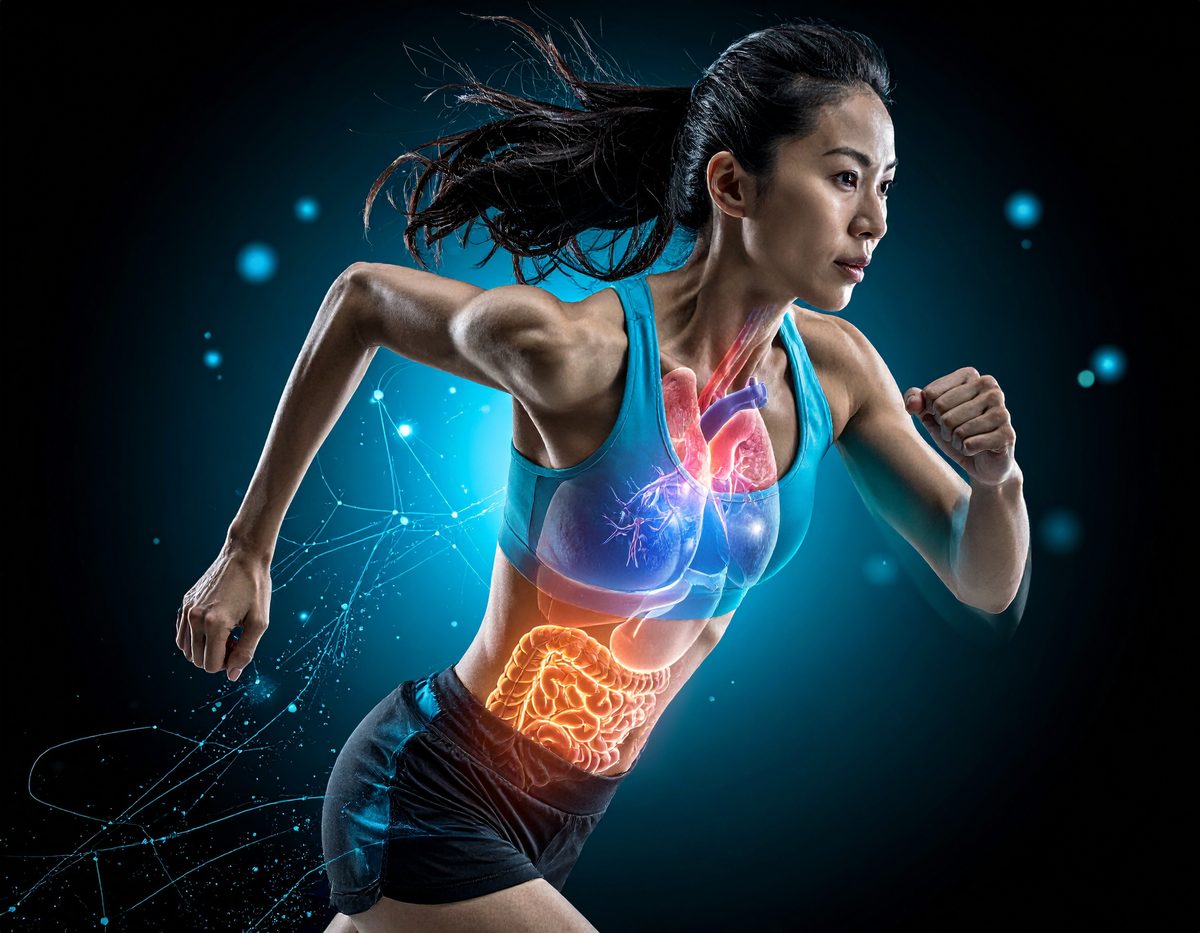
How your microbiome moves along with training, recovery and performance — five episodes.
- S4·E1 — Your gut trains too
- S4·E2 — Nutrition as fuel and as signal
- S4·E3 — Why one athlete recovers faster
- S4·E4 — Inflammation: ally and saboteur
- S4·E5 — Injuries often begin in the gut
Related concepts
Discover more in the Cosmogroup ecosystem
From knowledge to application — choose your next step.
My InnerSelfie
See which microbial substrate colors your VO₂max — DNA predisposition, SCFA profile and lactate conversion brought together in one picture.
Discover My InnerSelfie →My Key Nutrients
Support a favorable SCFA profile and lactate conversion with targeted fiber variation, tuned to your co-metabolism.
View the range →CosmoPulse
For performance environments: readiness, adaptation and recovery bundled into one readable decision signal.
Discover CosmoPulse →The books · HOST · FORMULA · EDGE
The common thread of this science, from insight to daily application, by Petra Van Gucht.
See the books →Scientific references
• Wegierska A.E., et al. (2022) — Gut microbiota and competitive sports recovery. Sports Medicine.
• Clark A., Mach N. (2017) — Gut microbiota–mitochondria crosstalk during exercise. Frontiers in Physiology.
• Van Gucht P. — EDGE (COSMO trilogy): endurance, energy and co-metabolism.
Frequently asked questions
- Do my heart and lung capacity alone determine my VO₂max?
- No. The microbiome counts too: short-chain fatty acids support mitochondrial function, so that muscles make more energy per molecule of oxygen.
- How does lactate become fuel?
- Certain bacteria (such as Veillonella) break down lactate and convert it into propionate, an SCFA that muscles can use again — less acidification, more endurance.
- Why does VO₂max differ between people with the same training?
- Predisposition (including PPARGC1A, ACE, FUT2 secretor status) and microbiome profile differ, so that one athlete naturally scores high while another benefits more from microbial support.
- Can I influence my SCFA production?
- Yes. A varied plant-based diet feeds SCFA-producing bacteria; which approach fits depends on your microbiome and predisposition.
Hooked on co-metabolism?
You have just read one piece of the puzzle. There is a path for the curious who want to understand themselves better — and a deeper library for the professional who works with it.
Discover your own story
Curious what co-metabolism means for you? Discover what your own body is trying to tell you every day — and stay up to date with new insights.
Discover your analysis →Join us and gain access
Become an affiliated healthcare professional and unlock the depth we reserve for our partners: the books to read online, the Well@Work and Sport experiences, the protocols and a network of like-minded people.
Join us →