
Brain fog & microbiome crosstalk
In plain language
After a stroke, a concussion, an intensive hospital admission or COVID-19, many people continue to struggle with a foggy head: memory loss, difficulty concentrating, fatigue and sometimes anxiety or low mood. The complaints are real, but MRI or standard blood tests often show nothing — which leaves people feeling unheard. Yet there is a biological explanation. The brain is in constant conversation with the gut and the immune system. An infection or intensive treatment can disrupt that conversation: the microbiome falls out of balance, inflammatory signals remain active, and the production of messenger substances shifts. In this way the brain, as it were, stays in a mild state of inflammation. That explains why cognitive recovery differs so much from person to person — and why it is something you can understand and support in a targeted way.
The science behind
A key route is the gut-brain axis. After a SARS-CoV-2 infection, damage to the microbiome contributes to “brain fog” via a disrupted balance of neurotransmitters and metabolites. Post-viral immune activation — partly via the spike protein — sustains a prolonged neuroinflammation, with neuroimmune crosstalk maintaining the brain inflammation in both long COVID and post-ICU patients. Up to almost half of ICU patients develop residual cognitive complaints, and long COVID is accompanied by a strongly increased risk of cognitive disorders.
Metabolic routes make the picture more concrete. Tryptophan metabolism can go two ways: via the serotonin pathway it contributes to focus and sleep recovery, via the kynurenine pathway instead to fatigue and low mood. Which route dominates helps color recovery. Inflammatory signals such as IL-6 and metabolites of the kynurenine pathway help explain why brain fog persists. Stress plays a part too: it disrupts the microbiome and, via pro-inflammatory signals, raises the likelihood of anxiety and low mood, in a loop that can reinforce itself.
Why one patient clears up quickly and another remains stuck is co-metabolic: it depends on the interplay between genetic predisposition, microbiome, metabolites and lifestyle. Genes color the sensitivity in the background, but the whole determines the picture. This reading is supportive and observational — not a medical diagnosis.
Illustration & CosmoTalks
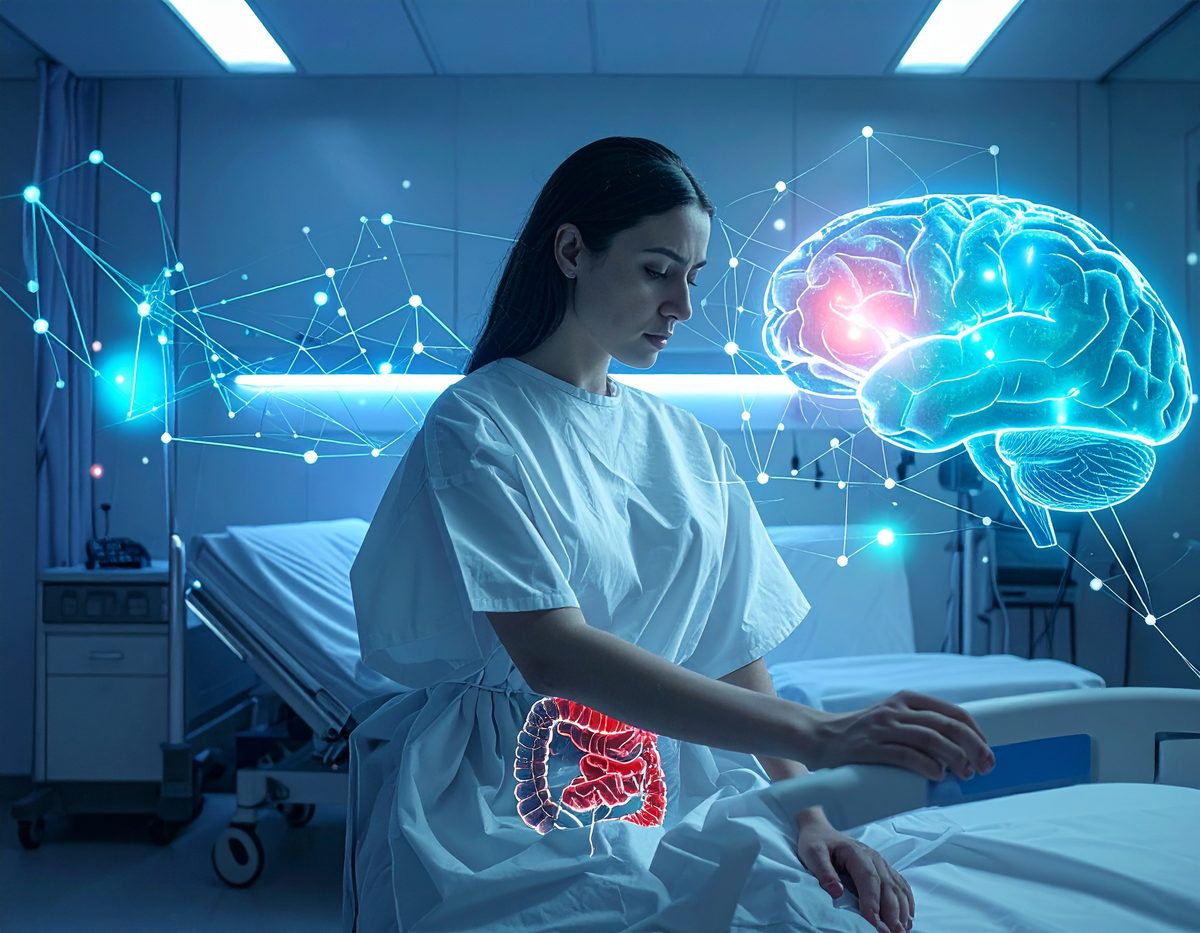
How your gut steers your mood and stress, in five short episodes.
- S3·E1 — Why mood is not only in your head
- S3·E2 — Your morning mood is not a character trait
- S3·E3 — Why stress hits your digestion first
- S3·E4 — Your microbiome has a day-night rhythm
- S3·E5 — Emotions are metabolic events
Related concepts
Explore further in the Cosmogroup ecosystem
From knowledge to application — choose your next step.
My InnerSelfie
Make visible how gut-brain communication influences your cognitive recovery: DNA, microbiome and metabolites together, translated into readable signals.
Discover My InnerSelfie →My Key Nutrients
Support your brain from within: nutrition and formulas that temper neuroinflammation and support tryptophan balance, tailored to your co-metabolism.
See the range →CosmoPulse
For performance settings: readiness, adaptation and recovery bundled into one readable decision signal.
Discover CosmoPulse →The books · HOST · FORMULA · EDGE
The common thread of this science, from insight to everyday application, by Petra Van Gucht.
See the books →Scientific references
• Talkington GMG., et al. (2025) — Neurological sequelae of long COVID: mechanisms and imaging. Front Neurol.
• Dos Reis RS., et al. (2024) — Neuroinflammation in post-COVID sequelae: neuroimmune crosstalk. Wiley.
• Van Gucht P. — HOST (COSMO trilogy): the brain as part of one ecosystem.
Frequently asked questions
- What exactly is brain fog?
- A persistent state of reduced concentration, memory and clarity, often after stroke, ICU admission or long COVID. It is real and biologically explicable, even if a scan shows nothing.
- What does my gut have to do with my concentration?
- The gut and the brain are in constant conversation via the gut-brain axis. A disrupted microbiome and persistent neuroinflammation can help determine focus, memory and mood.
- What is the kynurenine pathway?
- A branch of tryptophan metabolism that, when it dominates, goes hand in hand with fatigue and low mood — whereas the serotonin pathway instead supports focus and sleep recovery.
- Does this replace a neurological examination?
- No. Decisions remain with your neurologist or psychiatrist. A multi-omics reading is supportive and observational, not a diagnosis.
Bitten by co-metabolism?
You have just read one piece of the puzzle. There is a path for the curious who want to understand themselves better — and a deeper library for the professional who works with it.
Discover your own story
Curious what co-metabolism means for you? Discover what your own body tries to tell you every day — and stay up to date with new insights.
Discover your analysis →Join us and gain access
Become an affiliated healthcare professional and unlock the depth we reserve for our partners: the books to read online, the Well@Work and Sport experiences, the protocols and a network of like-minded people.
Join us →